
The TikTok branded content policy has become a critical framework for advertisers, creators, and agencies operating on the platform. As influencer marketing scales globally, TikTok has tightened its rules around transparency, disclosure, and commercial intent. For media buyers and performance-focused teams, this is no longer just a compliance topic—it directly impacts delivery, reach, and campaign efficiency.
Understanding how branded content is defined, how disclosure works, and what content is restricted is essential to avoid penalties and performance drops. This guide breaks down TikTok’s policy in a practical, execution-focused way, covering rules, risks, detection mechanisms, and best practices to help you run compliant and high-performing campaigns.
What Is TikTok Branded Content?
According to the official TikTok policy, branded content is any content that promotes a third-party brand, product, or service in exchange for a "commercial relationship." This is a broad term that TikTok interprets strictly. If there is an exchange of value, the content falls under this policy.
-
Sponsorships: Direct payment to a creator to feature a product.
-
Affiliate Marketing: Content where the creator receives a commission based on sales generated through links or codes.
-
Brand Collaboration: Partnerships where products are provided for free (gifting), or services are traded for exposure. Even if no cash changes hands, "gifting" is still a commercial relationship.
Why TikTok Branded Content Policy Exists
TikTok’s regulatory framework isn't just about bureaucracy; it’s about protecting the platform's most valuable asset: user attention. For media buyers, understanding the "why" helps in predicting future policy shifts.
Transparency and User Trust
TikTok prioritizes "authentic content." The platform’s algorithm thrives on the "For You" feed, feeling personal and genuine. If users feel they are being "tricked" into watching ads disguised as organic posts, engagement drops. Transparency through disclosure ensures that the user knows when they are being marketed to, which ironically can improve long-term trust and conversion rates.
Regulatory Compliance (FTC, ASA, EU Laws)
TikTok faces immense global legal pressure. The FTC (USA), ASA (UK), and various EU consumer protection agencies have become aggressive regarding "hidden ads." TikTok’s policy is designed to offload liability from the platform onto the user while ensuring the app remains compliant with international consumer protection laws.
Platform Integrity and Ad Ecosystem
TikTok wants to prevent "hidden ads" that bypass its paid ad infrastructure. By forcing disclosures, TikTok can better track commercial trends and encourage brands to use Spark Ads, the official method for boosting creator content. It ensures the ad ecosystem remains organized and measurable.
What Is Allowed Branded Content?
TikTok does not define “allowed branded content” as a fixed list of formats. Instead, branded content is permitted only when it meets specific compliance conditions set by the platform.
To remain compliant with the TikTok branded content policy, content must satisfy all of the following:
-
A commercial relationship is clearly disclosed using TikTok’s branded content tools or clear in-caption indicators
-
The content is truthful and not misleading, including any claims about products or services
-
It complies with both TikTok Community Guidelines and Advertising Policies
-
It does not promote prohibited products or services
In other words, TikTok allows branded content as long as it is transparent, accurate, and policy-compliant.
Within these boundaries, common compliant formats include:
-
Creator-led product reviews based on real experience
-
Tutorials or educational content featuring a brand
-
Lifestyle integrations where a product appears naturally
-
Affiliate-driven content with proper disclosure
The format itself is not restricted—the execution and disclosure determine whether the content is allowed.
What Is Prohibited Content?
This is the "Red Zone" for agencies. Violating these rules is the fastest way to get an account flagged or an entire campaign shut down. Based on TikTok’s Global BC Policy, certain categories and behaviors are strictly forbidden.
Prohibited Products and Industries
You cannot promote the following through branded content, regardless of disclosure:
-
Illegal Goods/Services: Drugs, weapons, and illicit activities.
-
Tobacco and Nicotine: Including vapes and E-cigarettes.
-
Adult Products: Anything of a sexual nature.
-
Certain Supplements: Weight loss pills or unregulated health "miracle" cures.
Deceptive Practices
-
Hidden Advertising: Attempting to hide the commercial nature of a video.
-
Misleading Claims: Claiming a skincare product cures a disease or a financial app guarantees wealth.
-
Fake Endorsements: Using AI-generated voices of celebrities or "expert" credentials (like doctor costumes) that are not verified.
Restricted Industries and Products
Some industries are not fully prohibited but are subject to additional restrictions, stricter review, and regional compliance requirements.
These categories require extra caution when producing branded content.
Common restricted industries
-
Financial services (e.g. trading platforms, crypto, lending)
-
Health and wellness (e.g. supplements, treatments, fitness claims)
-
Alcohol
-
Gambling and betting services
Key compliance requirements
For restricted industries, TikTok typically requires:
-
Full compliance with local laws and regulations in the target country
-
Accurate and verifiable claims, especially for financial and health-related content
-
Clear and prominent disclosure of commercial relationships
-
Additional limitations on targeting, messaging, or format, depending on the region
For example:
-
Financial content must avoid guaranteeing returns or minimizing risk
-
Health-related content cannot include exaggerated or unproven claims
-
Alcohol and gambling promotions may be restricted based on user age and location
Regional variation matters
One critical nuance often overlooked is that TikTok applies different rules depending on the market.
-
A category allowed in one country may be restricted or banned in another
-
Disclosure expectations may vary slightly but must always remain clear and visible
-
Certain industries require pre-approval or additional documentation
For advertisers operating globally, this means compliance cannot be standardized blindly; you need market-specific validation before launching campaigns.
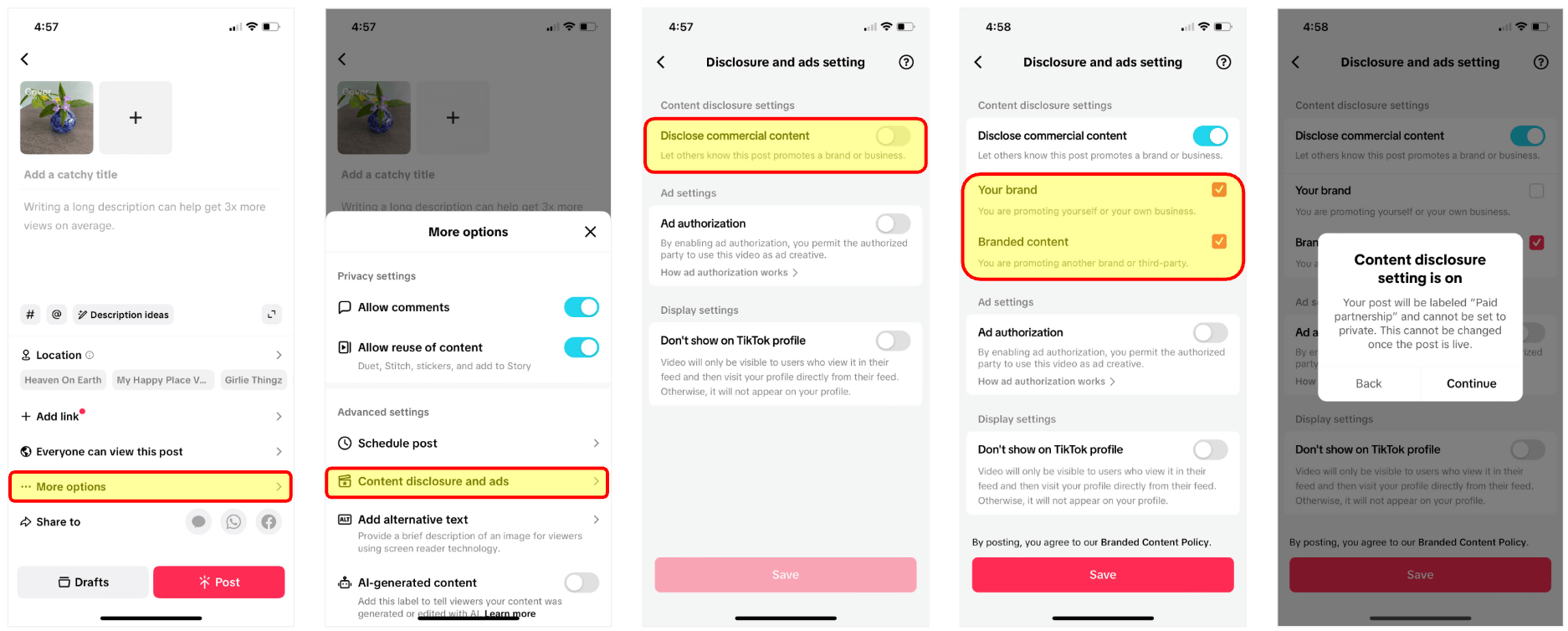
How to Disclose Branded Content Step by Step
Disclosure is the most critical part of the TikTok branded content policy. Incorrect or missing disclosure is the most common reason for violations.
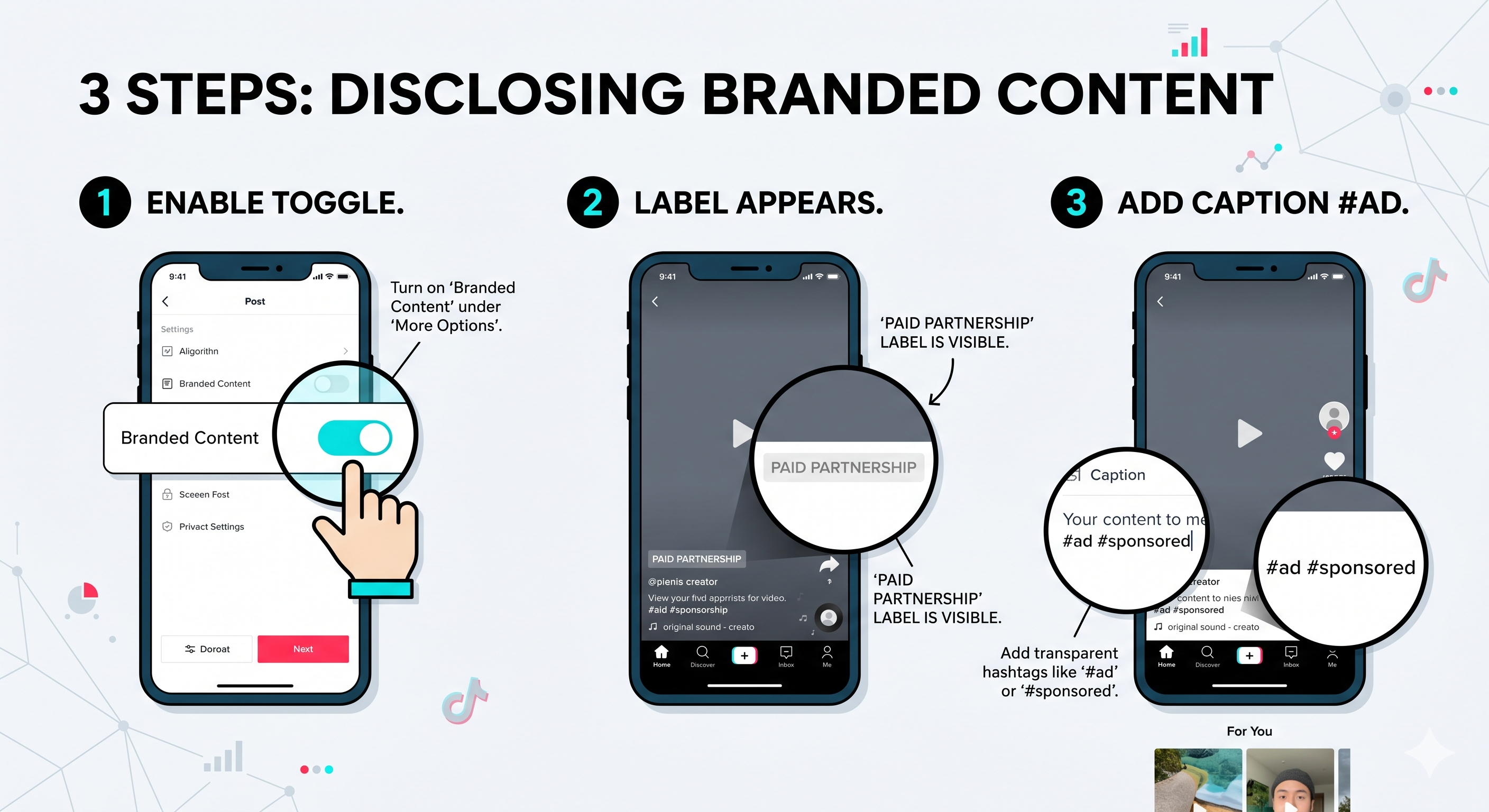
Branded Content Toggle (in-app tool)
TikTok provides a built-in Branded Content toggle that must be enabled when content involves a commercial relationship.
Key points:
-
Found in video posting settings
-
Activates official disclosure labeling
-
Signals compliance to TikTok systems
Failure to use this feature is a major red flag for the platform.
Paid Partnership Label
When the toggle is enabled, TikTok adds a Paid Partnership label to the content.
This label:
-
Appears directly on the video
-
Is visible to users immediately
-
Meets disclosure requirements in most regions
It should be used whenever applicable, even if the creator also includes caption disclosures.
Caption-level disclosure
In addition to platform tools, caption-based disclosure is recommended.
Examples include:
-
#ad
-
#sponsored
-
#paidpartnership
Best practices:
-
Place disclosure at the beginning of the caption
-
Avoid hiding it among multiple hashtags
-
Use clear and commonly understood terms
What “clear and conspicuous” means
Disclosure must be:
-
Easy to notice
-
Easy to understand
-
Not buried or obscured
For advanced advertisers, this is where many mistakes happen. Subtle or ambiguous disclosure increases compliance risk.
How TikTok Detects and Reviews Branded Content
Many marketers wonder how TikTok knows a video is an ad before they even put money behind it. The platform uses a multi-layered detection system that is far more advanced than most realize.
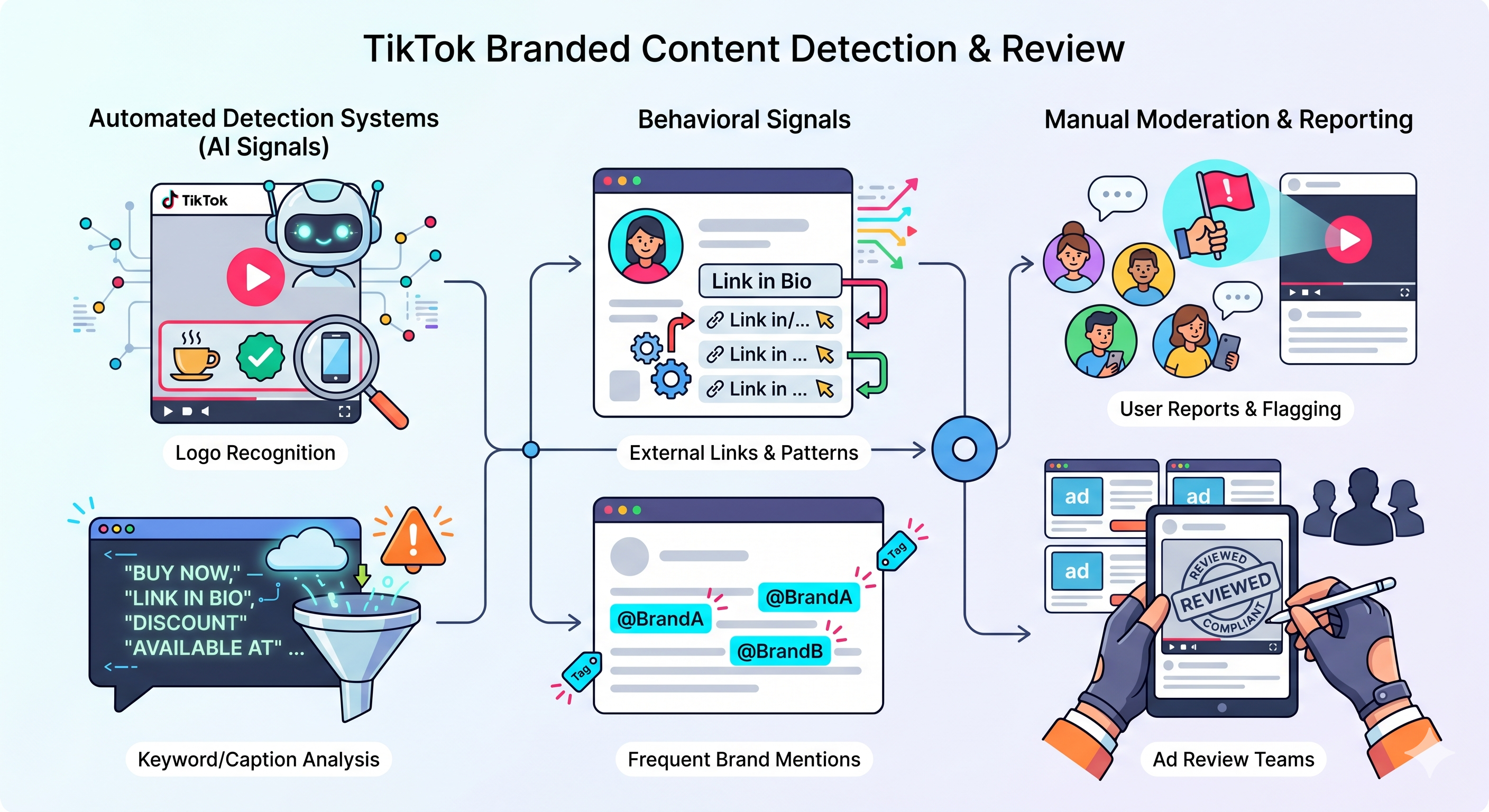
Automated Detection Systems (AI Signals)
TikTok’s computer vision scans every frame of a video.
-
Logo Recognition: If a Nike or Starbucks logo appears prominently, the AI flags it for review.
-
Keyword/Caption Analysis: Words like "buy now," "link in bio," "discount," or "available at" trigger an automatic check for the Branded Content toggle.
Behavioral Signals
The algorithm looks for "affiliate patterns."
-
External links: If a creator’s profile link frequently changes to redirected affiliate URLs, their videos are scrutinized more heavily.
-
Brand Mentions: Frequent tagging of brand accounts in the captions.
Manual Moderation & Reporting
-
User reports: Competitors or viewers can report a video for "undisclosed branded content."
-
Ad Review Teams: Once a video is "Sparked" (turned into an ad), it undergoes a manual human review to ensure it meets both the BC policy and the stricter Advertising Guidelines.
How to Comply with TikTok Branded Content Policy
Compliance should be baked into your creative production workflow. Here is how different stakeholders should handle it:
For Creators
-
Always Disclose: If you got the product for free, use the toggle. Don't risk your account for a "cleaner" look.
-
Avoid Exaggerated Claims: Don't promise results that the brand hasn't legally cleared.
-
Use the Library: Check TikTok's Commercial Music Library. Using copyrighted pop songs in branded content is a major violation.
For Brands
-
Compliance Briefs: Every influencer brief should include a "Compliance Checklist" that mandates the use of the BC Toggle.
-
Review Before Posting: Request a "draft" or "preview link" from the creator to ensure they have the disclosure settings correct before the video goes live.
For Agencies
-
Approval Workflows: Implement a multi-step approval process. The creative team makes the video, but a "Compliance Officer" or Account Manager must verify the disclosure settings.
-
Pre-check Compliance: Use tools to scan creator content for potential policy triggers (like background logos or unlicensed music) before the campaign launches.
FAQs
Can brands retroactively add disclosures to older TikTok videos?
No. Once a video is posted, you cannot toggle the Branded Content setting on. You would need to delete the video and re-upload it with the toggle enabled, which would mean losing all previous engagement and views.
How do branded content disclosures affect TikTok Spark Ads performance?
Actually, they often improve it. While some fear the "Paid Partnership" label reduces "authenticity," it actually allows for better tracking. Spark Ads using the BC toggle have access to more granular data in the TikTok Ads Manager, allowing for better optimization.
What happens if I enable branded content?
Enabling the toggle does three things: 1) It adds the "Paid Partnership" label. 2) It gives the brand you've tagged permission to see your video's performance metrics. 3) It generates a "Video Code" that the brand can use to run the video as a Spark Ad.
Do I need to disclose if I bought the product with my own money but want to be an affiliate?
Yes. If you include an affiliate link or code that earns you money, it is a commercial relationship, regardless of how you acquired the product initially.
Does the policy apply to TikTok Live?
Absolutely. If you are promoting products on a Live stream for a brand, you must use the "Promotional Content" setting within the Live dashboard to disclose the partnership to viewers.
Related posts: