
TikTok brand safety has become a critical concern for advertisers running campaigns on one of the world’s fastest-growing social platforms. Because TikTok relies heavily on user-generated video content, ads can potentially appear next to videos that include harmful or controversial topics.
To address these concerns, TikTok has introduced a range of brand safety controls and moderation systems designed to help advertisers protect their campaigns. These include AI-driven content classification, advertiser-controlled placement filters, and multiple tools for adjusting the level of content sensitivity around ads.
This article explains what TikTok brand safety means, how the platform protects advertisers, which brand safety tools are available inside TikTok Ads Manager, and the best practices marketers can use to maintain safe and effective campaigns.
What Is TikTok Brand Safety?
In digital advertising, brand safety refers to the practice of ensuring that advertisements do not appear alongside content that could harm a brand’s reputation. If ads are shown next to sensitive or inappropriate material, audiences may associate the advertiser with that content. Even when the brand has no control over the surrounding media, the perceived connection can still affect brand trust.
Examples of unsafe content commonly referenced in brand safety discussions include:
-
violence or graphic imagery
-
hate speech or discrimination
-
extremist or terrorist content
-
explicit adult material
-
misinformation or misleading claims
Why Brand Safety Matters in TikTok Advertising
For seasoned advertisers running high-budget campaigns, the risks of ignoring brand safety far outweigh any potential reach gains. Here is why it must be a top-tier priority:
1. Protecting Brand Reputation
A single "bad placement" can go viral for the wrong reasons. If a family-friendly brand appears next to a video featuring dangerous stunts or offensive language, the brand’s image can be tarnished instantly.
2. Maintaining Consumer Trust
Psychologically, users often hold the advertiser responsible for the content they are consuming. They assume the brand has chosen—or at least approved—the environment in which its ad is seen. Maintaining a clean environment reinforces that your brand is a responsible actor.
3. Preventing PR Risks and Backlash
Social media moves fast. A screenshot of an ad next to controversial content can lead to a boycott or a PR nightmare within hours. Ensuring brand safety is a proactive defensive strategy against social media backlash.
4. Improving Ad Performance
There is a direct correlation between environment and effectiveness. Ads running in high-quality, safe environments typically see higher trust levels, leading to better engagement and conversion rates. When users feel safe, they are more likely to interact with the brands they see.
Brand-safe placements do more than protect reputation — they can also improve campaign efficiency. Learn how TikTok Ads optimization strategies help advertisers increase engagement, lower CPA, and improve delivery quality.
How TikTok Ensures Brand Safety?
TikTok's defense system is a sophisticated "filter" designed to catch problematic content at various stages of the content lifecycle.
Community Guidelines
The first line of defense is the TikTok Community Guidelines. These rules apply to all users and creators. Any content that violates these (e.g., harassment, dangerous acts, or explicit material) is removed from the platform entirely, meaning it never even enters the pool of content where ads could appear.
AI Content Moderation
TikTok employs cutting-edge machine learning to scan every upload. The AI doesn't just look at the video imagery; it analyzes:
-
Audio/Speech-to-Text: Detecting forbidden keywords or offensive audio.
-
Captions and Hashtags: Contextualizing the intent of the video.
-
Metadata: Looking for patterns of behavior that indicate bot activity or spam.
Human Moderation
Because AI can sometimes miss nuance (like satire or cultural context), TikTok maintains a global team of thousands of human reviewers. These specialists provide a manual check on flagged content, ensuring that the classification is accurate and that subtle violations are addressed.
Types of Brand Safety on TikTok
Inside the advertising interface, TikTok provides multiple settings that allow advertisers to control campaign environments. These settings are designed to manage risk both before ads are delivered and after impressions occur.
Understanding these options allows advertisers to build a safer campaign setup.
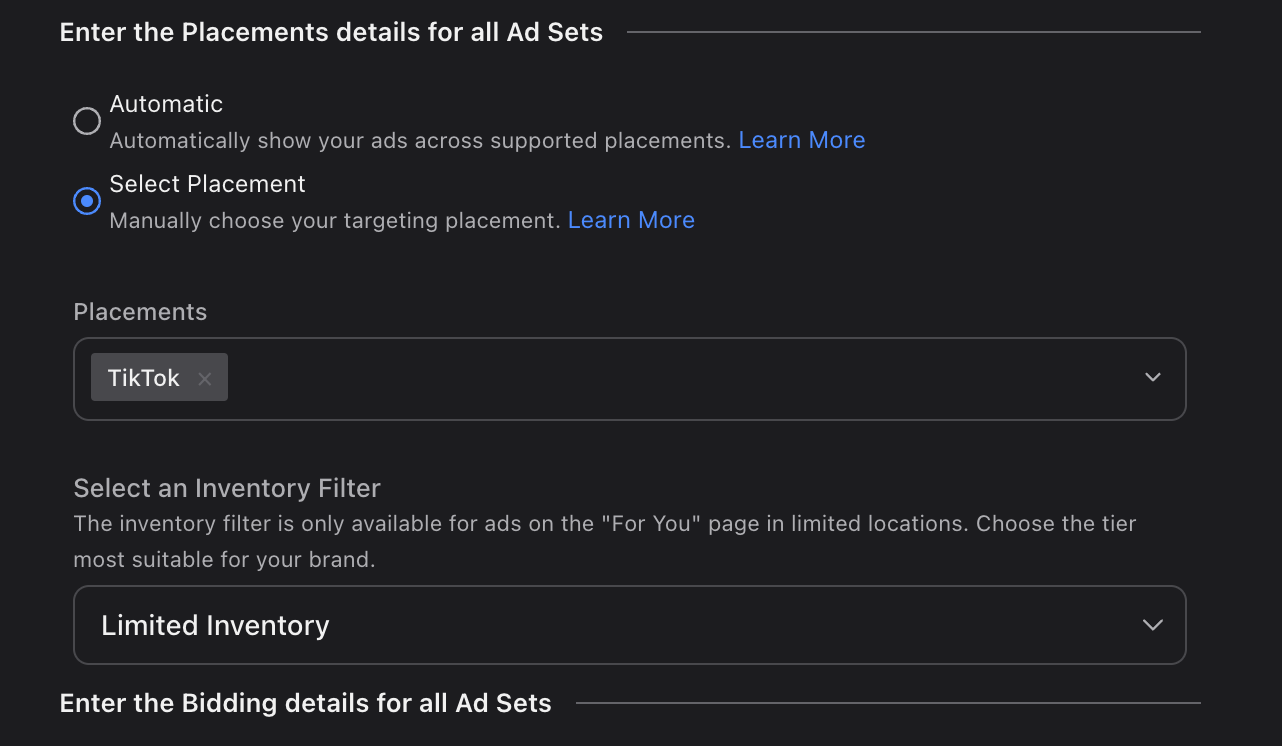
Set Pre-bid Brand Safety
Pre-bid solutions allow you to filter out certain types of inventory before you spend a single cent.
-
TikTok Inventory Filter: This is the primary tool. You can choose from three tiers:
-
Full Inventory: Ads may appear next to all content that meets Community Guidelines.
-
Standard Inventory: Excludes content with moderate mature themes (the "Goldilocks" zone for most brands).
-
Limited Inventory: The strictest setting, excluding any content with mature themes.
Post-Bid Brand Safety
Post-bid tools measure and audit placements after impressions are served — essential for independent verification and stakeholder reporting.
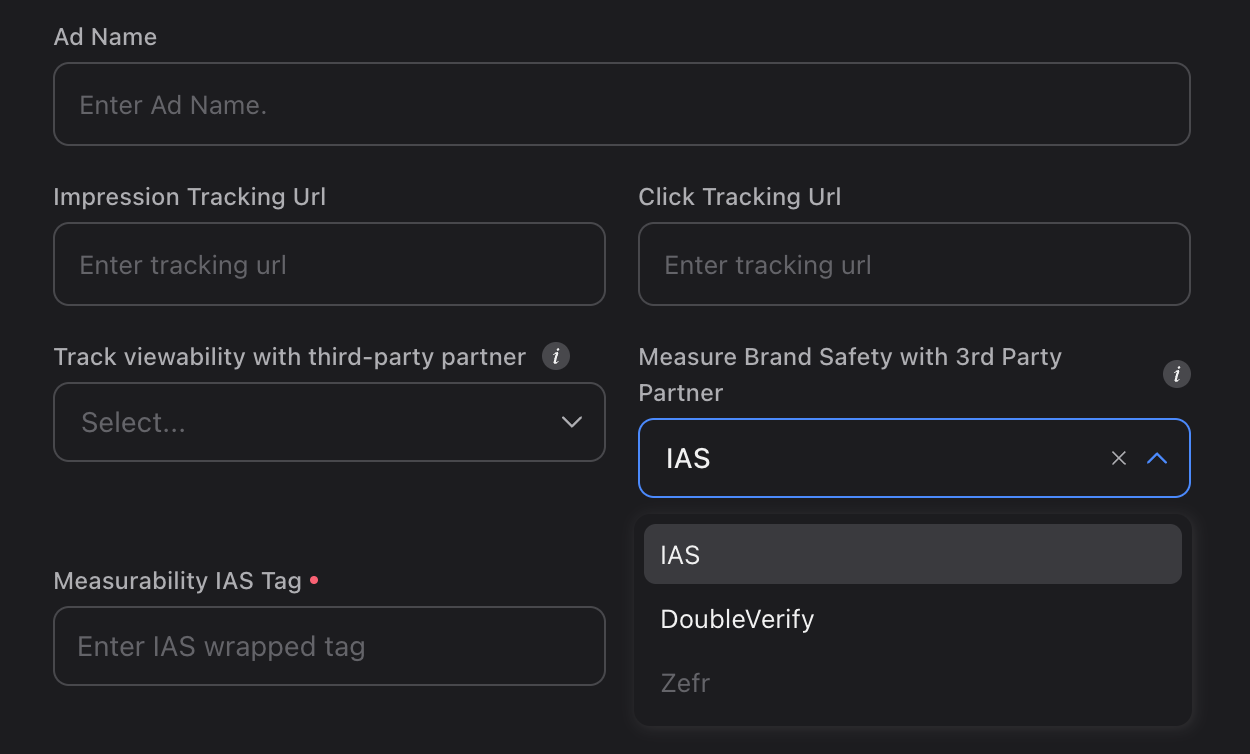
Third-Party Brand Safety Measurement (configured at Ad Variant level)
Available partners: IAS, DoubleVerify, Zefr
-
IAS requires an IAS-wrapped tag to be input into the platform
-
Supported objectives: Reach, Video Views, App Promotion, Website Conversions, Traffic, Community Interactions, Product Sales, Lead Generation
-
Zefr is not supported for Product Sales
-
Requires a pre-bid Inventory Filter (Standard/Limited) or pre-bid third-party partner to be active first
Third-Party Viewability Measurement (configured at Ad Variant level)
Available partners: IAS, DoubleVerify, MOAT
-
If using IAS for both measurement and viewability, use the same tag to avoid double-counting
-
Supported objectives: Reach, Video Views, App Promotion, Website Conversions, Traffic, Community Interactions, Product Sales
Pangle Block List
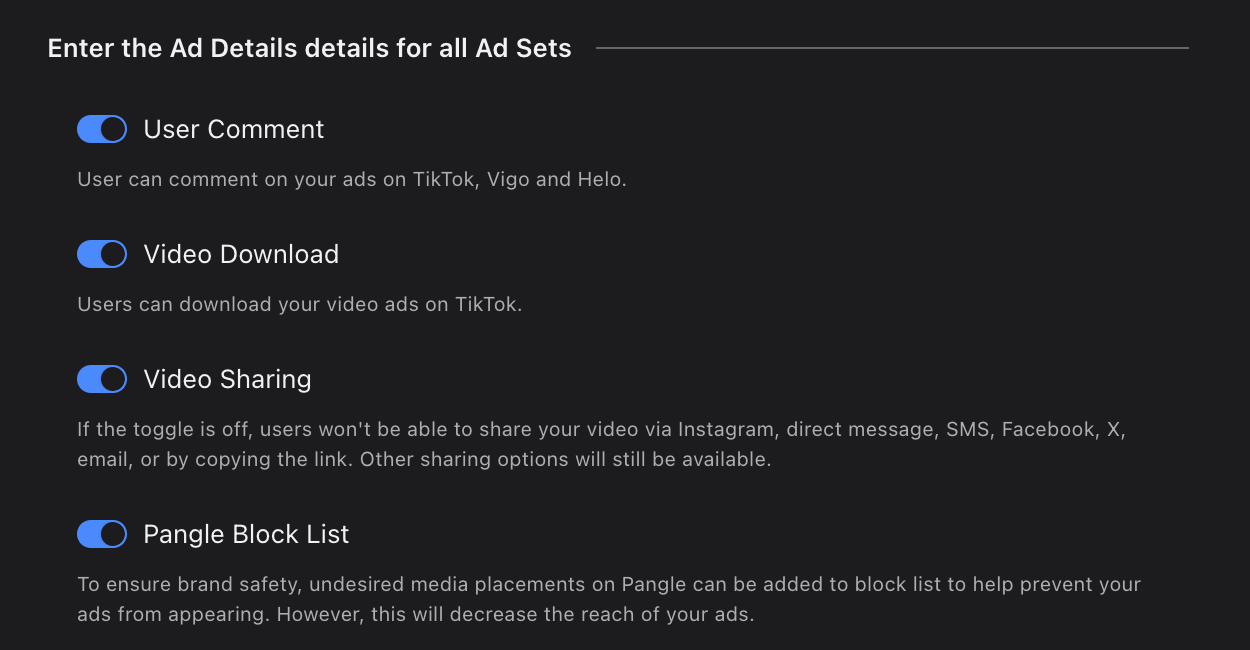
For campaigns using Pangle placements (TikTok's in-app advertising network), you can build a block list of specific apps or placements to exclude.
-
Configured at the account level in TikTok Ads Manager
-
Adding placements to the block list will reduce overall reach
-
Useful for advertisers with specific publisher exclusion requirements
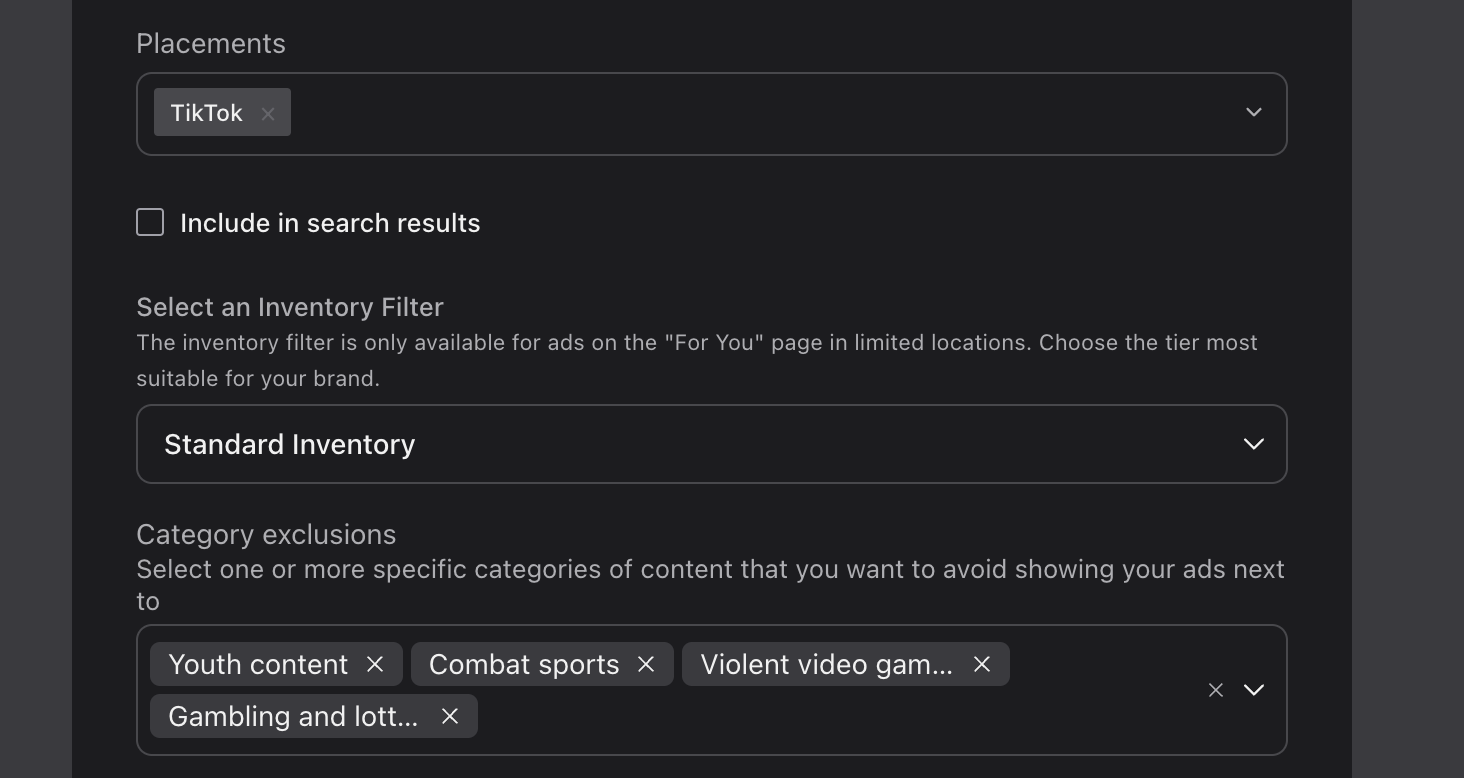
Category Exclusions
Category Exclusion is a brand suitability tool — it lets you exclude content categories that don't fit your brand, even if that content is permitted on the platform.
How to activate:
-
Set Inventory Filter to Standard or Limited
-
Select exclusion categories under "Category Exclusions."
Excludable categories include: violent extremism, dangerous acts, adult nudity, self-harm, harassment, illegal activities, and more.
Vertical Sensitivity
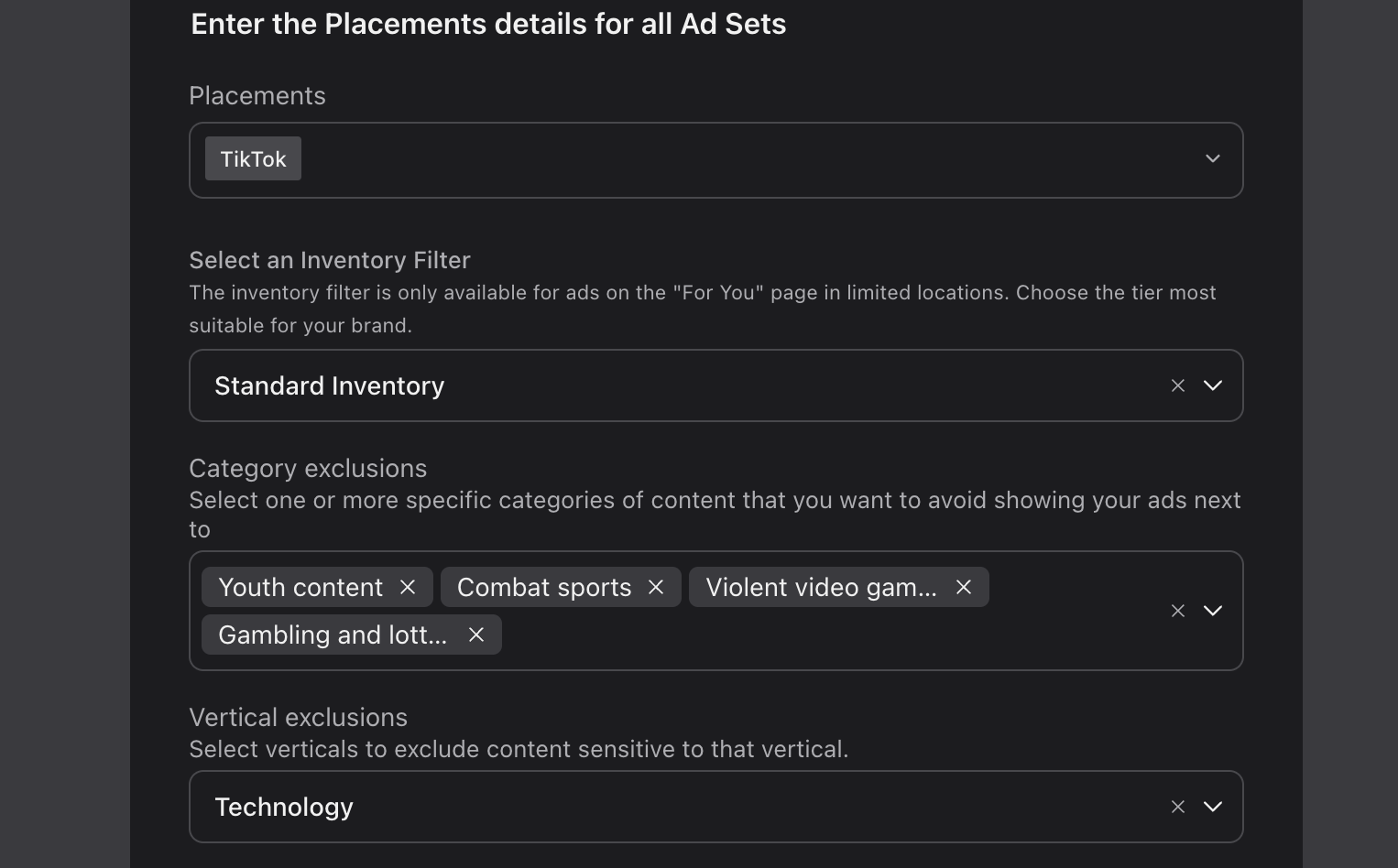
Vertical Sensitivity adds an industry-specific layer of protection, letting you exclude content tied to specific verticals that may conflict with your brand's positioning.
How to activate:
-
Set Inventory Filter to Standard or Limited
-
Select up to one vertical under "Vertical Exclusions."
Brand Safety Risks on User-Generated Platforms
Despite the tools, the nature of a UGC platform like TikTok introduces inherent risks that require constant vigilance.
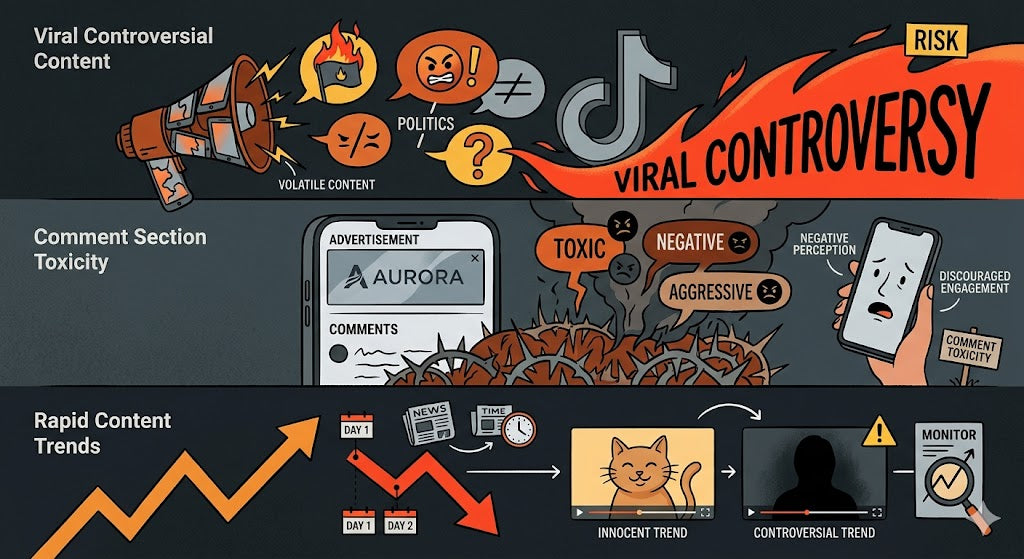
Viral Controversial Content
Trends on TikTok move at lightning speed. A soundbite or a challenge that is perfectly innocent today could be co-opted for a controversial political debate tomorrow. By the time the AI flags it, your ad might have already appeared.
Comment Section Toxicity
Even if the video itself is brand-safe, the comment section can be the wild west. "Trolls" or spam bots can clutter the comments under your ad with offensive material. Advertisers should use TikTok’s Comment Management tools (keyword filters and manual hiding) to protect the conversation around their brand.
Rapid Content Trends
Content that starts as a harmless prank can sometimes evolve into something dangerous or exclusionary. This is why regular placement audits are necessary for high-stakes campaigns.
Brand Safety Risks on User-Generated Platforms
Even with advanced moderation systems, advertising on a user-generated platform always involves certain risks. TikTok’s rapid content creation cycle means trends and conversations can shift quickly.
Advertisers should understand the most common challenges.
Viral Controversial Content
TikTok’s algorithm often promotes highly engaging videos regardless of topic. Sometimes controversial or emotionally charged content spreads quickly.
Topics that may present risk include:
-
sensitive social discussions
-
political commentary
-
controversial humor
If an ad appears alongside such content, the brand may unintentionally become associated with the conversation.
Comment Section Toxicity
Another potential risk comes from user comments. Even when a video itself is harmless, the comment section may include offensive or aggressive remarks.
Negative comments appearing below an advertisement can affect brand perception and discourage engagement.
Rapid Content Trends
TikTok trends evolve extremely fast. A topic that seems harmless today may become controversial tomorrow due to changing public perception or news events.
Because of this volatility, advertisers should regularly monitor campaign placements and adjust brand safety settings when necessary.
Proper TikTok Ads analytics helps advertisers monitor placement quality, engagement trends, conversion performance, and brand safety risks more effectively.
Brand Safety vs Brand Suitability on TikTok
Although these two concepts are closely related, brand safety and brand suitability represent different levels of content control.
Understanding the distinction helps advertisers build more precise placement strategies.
Brand Safety
Brand safety refers to content that is strictly unsuitable for advertising because it violates platform policies or community standards.
Examples include:
-
violent or dangerous behavior
-
illegal activities
-
harassment or hate speech
-
explicit or adult material
Content in these categories is typically restricted from advertising environments entirely.
Brand Suitability
Brand suitability goes one step further. It refers to content that may not violate platform policies but could still feel inappropriate for a specific brand.
Examples might include:
-
dark humor or edgy jokes
-
sensitive social issues
-
political debates or commentary
Some brands are comfortable appearing alongside this type of content, while others prefer to avoid it.
|
Brand Safety |
Brand Suitability |
|
|
What it covers |
Content violating TikTok's policies |
Content that's permitted but may not fit your brand |
|
Examples |
Violence, hate speech, illegal activity |
Dark humor, political debates, mature themes |
|
Who controls it |
TikTok's moderation systems |
Advertiser-level settings |
|
Flexibility |
Non-negotiable floor |
Fully customizable |
FAQs
Does using the "Limited Inventory" filter hurt my performance?
It can. By restricting your ad to a smaller pool of content, you may see a higher TikTok CPM (Cost Per Mille) because there is less "safe" space available for everyone. However, for many brands, the higher cost is a worthwhile trade-off for the reduced risk.
Can I block specific TikTok creators from showing my ads?
Currently, TikTok does not offer a public "Creator Block List" for In-Feed ads. However, you can use Category Exclusions and Inventory Filters to significantly narrow down the type of creators your ads appear next to.
How often should I check my Brand Safety reports?
For high-volume campaigns, a weekly review of third-party verification data is standard. If you are running during a major news event or a controversial social period, daily monitoring of comment sentiment is recommended.
How does TikTok classify content for brand safety?
TikTok uses machine learning models to analyze video imagery, audio, captions, and metadata. This analysis helps classify content into different risk categories used by brand safety filters.
Can advertisers control where TikTok ads appear?
Yes. Advertisers can use inventory filters, category exclusions, block lists, and vertical sensitivity controls to manage where their ads are shown.
Why is brand safety especially important on TikTok?
Because TikTok is built on user-generated content, advertisers cannot fully control the surrounding media environment. Brand safety tools help reduce the risk of ads appearing next to controversial or inappropriate content.
Read more: