
Setting up a shop is a technicality; building a high-revenue machine is an art. If you are reading this, you likely already understand the fundamentals of digital advertising. You’ve seen the explosive growth of social commerce, and you know that how to sell on TikTok Shop effectively isn't about filling out a profile—it’s about mastering a content-commerce hybrid that moves faster than any traditional marketplace.
Most guides on the internet focus on the "how-to" of button-clicking. This guide is different. We are diving deep into a comprehensive TikTok Shop strategy and advanced selling tips designed for media buyers, brand owners, and e-commerce managers who want to scale from zero to high-six figures. In 2026, TikTok Shop isn't just an "add-on" sales channel; it’s a discovery-led ecosystem that requires a total shift in how you view the customer journey.
Pros and Cons of Selling on TikTok Shop
Before allocating a massive ad budget, it's vital to have a clear-eyed view of the landscape. Every high-growth platform comes with trade-offs.
The Pros:
-
Massive Organic Reach: Unlike other social platforms, TikTok still allows for "viral" sales spikes without a massive following.
-
Integrated Ad Suite: The synergy between organic content and paid Ads Manager is seamless.
-
Creator Ecosystem: The Affiliate Center allows you to hire a "sales force" on a pure commission basis.
The Cons:
-
Strict Logistics: TikTok is ruthless about shipping SLAs. If you can’t ship within 48 hours, they will throttle your traffic.
-
Content Burnout: Creative fatigue happens fast. You cannot run the same ad for 6 months like you can on Meta.
-
Platform Dependency: You are playing in TikTok's backyard; a policy shift can impact your GMV overnight.
3 Core Ways to Sell on TikTok Shop
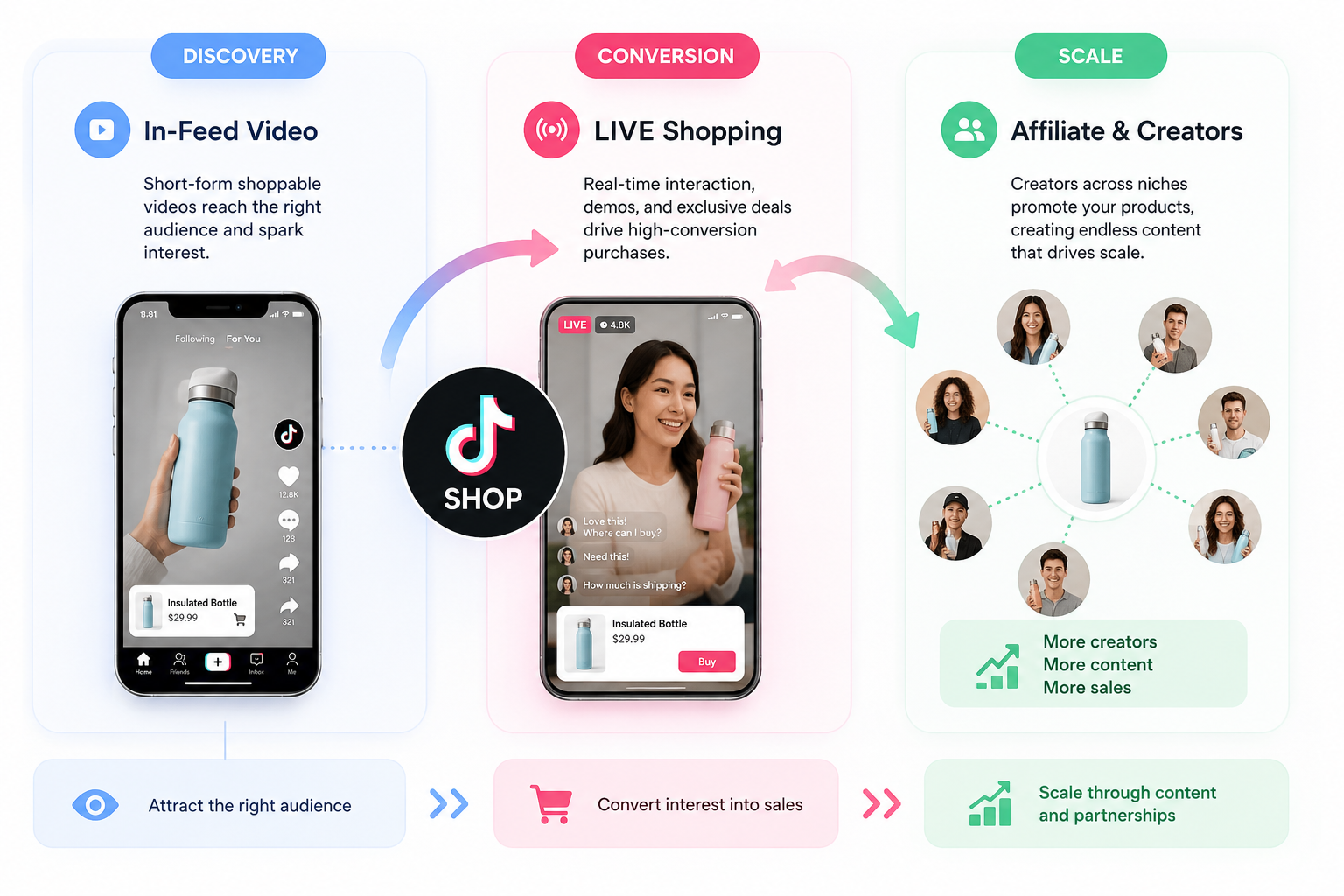
There are three primary monetization paths inside TikTok Shop. Each serves a different role in your growth strategy.
In-Feed Video Selling
In-feed shoppable videos are the primary discovery engine. You tag a product in a short-form video, TikTok distributes it to relevant users, and they tap directly to your listing.
Why is this your scalable entry point:
-
The same video asset works for both organic distribution and paid amplification
-
A video that converts organically becomes the raw material for a GMV Max campaign
-
You're building one asset pool that serves both organic and paid, not separate creative pipelines
Best for: product launches, broad awareness, creative format testing, feeding the affiliate content pool
TikTok LIVE Selling
LIVE shopping creates a buying environment that static content can't replicate. Conversion rates are consistently 2–5× higher than in-feed video because of real-time social proof, immediate Q&A, scarcity mechanisms, and a host who can adapt to audience objections on the fly.
Best for:
-
Products that benefit from live demonstration (beauty, kitchen, fitness gear)
-
Mid-to-high ticket items where trust needs to be built before purchase ($20–$80+ sweet spot)
-
Re-engaging an audience that already knows your brand
Affiliate and Creator Marketplace
The TikTok Shop affiliate program lets you set commission rates and make products available for any eligible creator to promote. They find your products, create content, and earn commission when their audience buys.
The scale advantage:
-
Your owned content: 5–10 videos per week
-
A properly activated affiliate program: hundreds of videos per week across different creator niches and audience types
-
Some brands generate 80%+ of total TikTok Shop GMV through affiliates, not owned content
Best for: scaling reach beyond what your account can generate, products with margins that support 10–25%+ commissions, building content volume that feeds the GMV Max algorithm.
How To Sell On TikTok Shop: Content Strategy
The biggest mistake professional media buyers make is bringing "over-produced" ads to TikTok. On this platform, authenticity is the new high-definition. Your content needs to feel native to the feed while following a strict sales psychology.
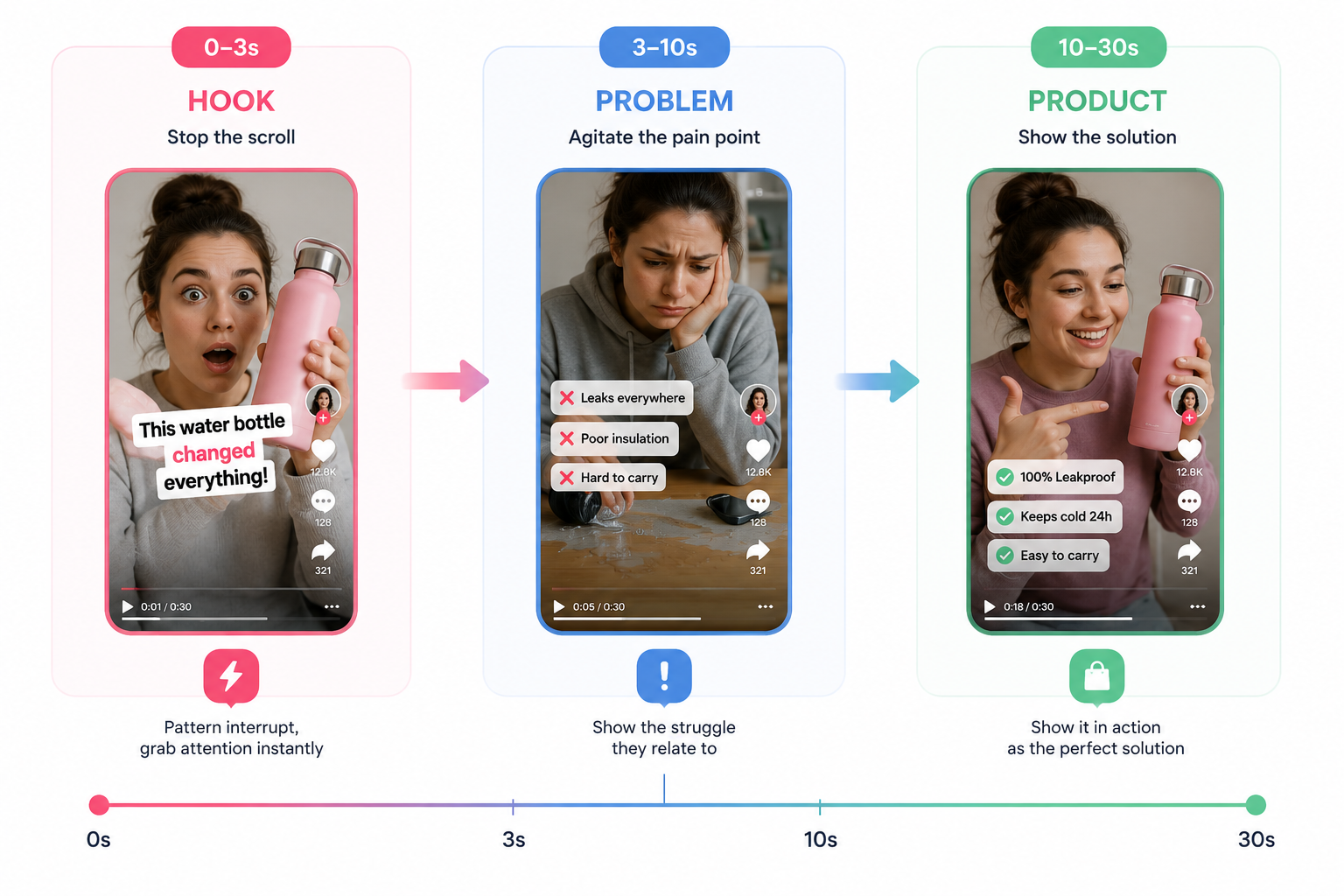
The Hook → Problem → Product Formula
This is the "Golden Ratio" of TikTok commerce content:
-
The Hook (0-3s): Stop the scroll with a visual pattern interrupt or a polarizing statement.
-
The Problem (3-10s): Agitate a specific pain point that your target audience feels deeply.
-
The Product (10-30s): Show the product in use as the immediate solution. No fluff, just results.
High-Converting Content Formats
-
Before/After: The most classic conversion driver. Visual proof of transformation is undeniable.
-
“TikTok Made Me Buy It”: Utilizing social proof by showing why a product is trending.
-
POV / Storytelling: Relatable narratives that put the viewer in the shoes of the person using the product.
-
Unboxing: Tapping into the "dopamine hit" of receiving a new package.
Once a winning format starts generating traction organically, many brands move into TikTok Spark Ads to amplify posts while preserving engagement and social proof.
Posting System
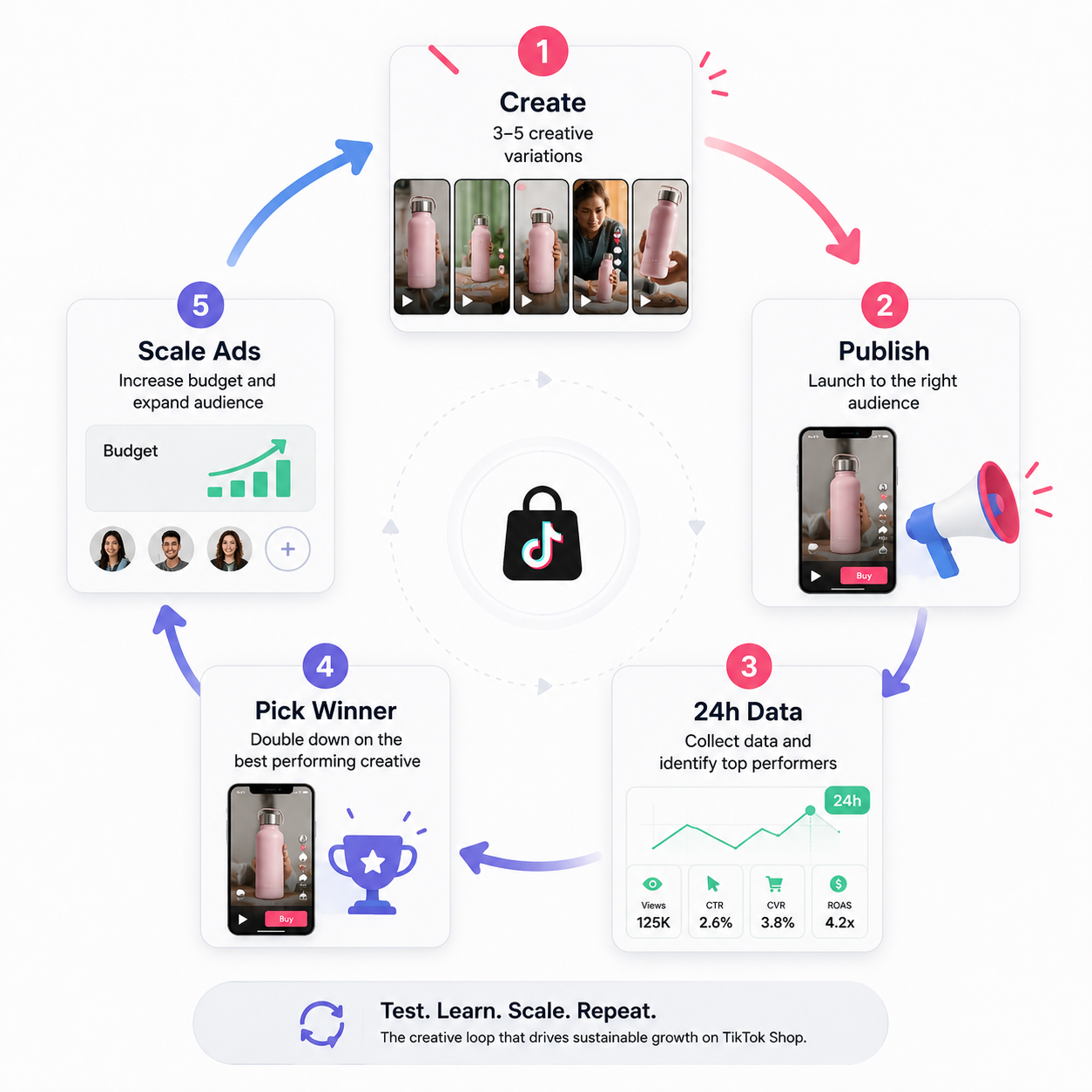
You need a creative testing loop. Instead of betting on one "perfect" video, post 3-5 variations of a concept. Change the hook, change the music, or change the CTA. Use the data from the first 24 hours to decide which version gets the ad spend. This is a Volume + Quality game.
Scaling Winning Content With TikTok Ads
Organic reach is powerful for testing products, but most serious TikTok Shop sellers use paid ads to scale consistently.
Once a video generates strong watch time, engagement, product clicks, or conversions, sellers often amplify it through Spark Ads. Because Spark Ads preserve existing likes, comments, and social proof, they usually feel more native to the feed and outperform overly polished creatives.
Many sellers also combine:
-
Spark Ads
-
Video Shopping Ads
-
LIVE Shopping Ads
-
GMV Max campaigns
to scale products that already proved they can convert organically.
However, as budgets grow, scaling often becomes an infrastructure challenge rather than a creative problem. Sellers may face spending limits, account reviews, billing instability, or campaign interruptions during aggressive scaling phases.
This is why many growing TikTok Shop brands work with partners like AGrowth for premium TikTok agency ad account solutions to scale TikTok Shop campaigns with higher spending capacity, more stable delivery, and reduced disruption during aggressive growth phases.
AGROWTH - TIKTOK AGENCY ACCOUNT
⭐ Managed campaigns with expert guidance
⭐ Flexible invoice-based billings, custom top-ups
⭐ High resistance to suspension via agency tier
⭐ Quick fund transfer to new account if needed
⭐ Lower rates from 3%
LIVE Shopping Strategy: How to Build Sessions That Actually Sell
Live shopping is often misunderstood as "just talking to the camera." In reality, a successful LIVE is a high-pressure sales environment fueled by real-time social proof and scarcity.
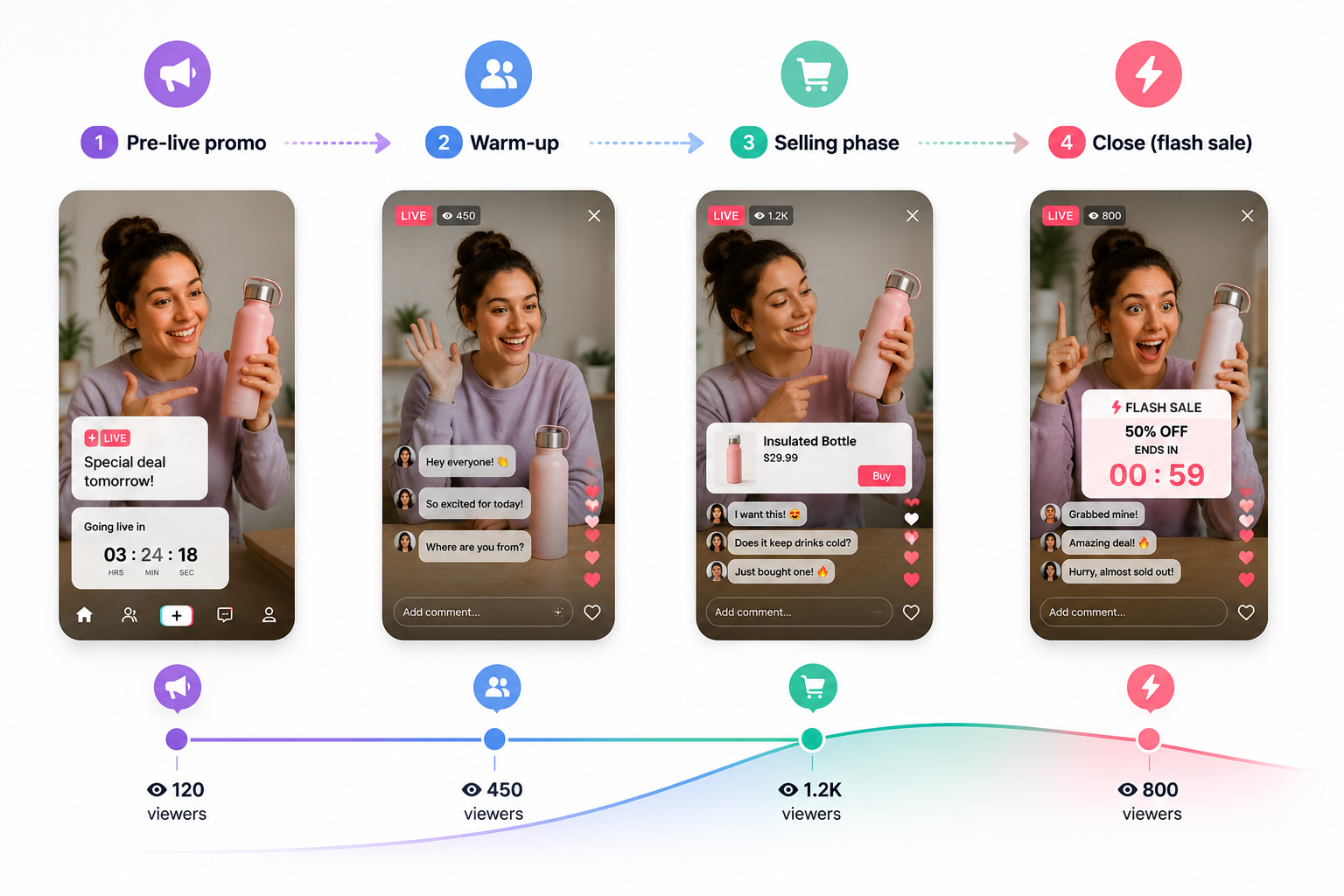
The Session Structure
-
Pre-LIVE Promo: Post a "hook" video 2-3 hours before you go live, announcing a special deal.
-
The Warm-up Phase: Build the room. Don't start selling the main product until the viewer count stabilizes. Engage with the early birds.
-
The Selling Phase: This is where you demo, pin the product card, and use a strong CTA. Repetition is key here—new people are joining every second.
-
The Close: Recap the best-sellers and offer a "Final 10 Minutes" flash price to clear remaining stock.
LIVE GMV Max Ads
For those with an ads background, GMV Max is your best friend. This campaign type uses AI to amplify your LIVE sessions to users most likely to buy.
-
Budget Recommendation: Set your daily budget to at least 10x your Average Order Value (AOV).
-
Strategy: Use "Max Delivery" during the peak hours of your LIVE to flood the room with traffic.
Consistency Matters: TikTok’s algorithm rewards "Cadence." If you go live 3 times a week at the same time, the algorithm learns who your audience is and starts pre-emptively pushing your stream to them.
TikTok Creator & Affiliate Scaling System
If you want to reach $1M+ in monthly GMV, you cannot do it alone. You need a "Creator Army." The real secret to TikTok Shop success is building a systematic outreach and management program.
How to Recruit Creators at Scale
Move away from manual DMs. Use the TikTok Shop Creator Network tools to filter for creators in your niche with high engagement and a history of sales.
-
Outreach Strategy: Offer a free sample immediately. Don't ask for a video first; lead with value.
-
Paid Seeding: For high-potential creators, consider a small "flat fee" plus commission to ensure they prioritize your product in their content calendar.
The “40 Creator Model”
Aim to have at least 40 different creators testing the same product simultaneously. This creates an "omnipresence" effect. When a user sees three different people talking about the same product in one day, the conversion is almost guaranteed.
Managing Affiliate Performance
Not all creators are equal. Create Commission Tiers.
-
Tier 1 (New): 10% commission.
-
Tier 2 (Proven): 15% commission + exclusive discount codes.
-
Tier 3 (Partners): 20% commission + "Whitelisted" access for Spark Ads.
Common Mistakes That Kill TikTok Shop Sales
These show up consistently in new seller accounts — including from experienced e-commerce operators who apply the wrong mental model to the channel.
Treating TikTok Shop like a search platform
Optimizing listings, waiting for traffic, running standard product ads — and getting confused when nothing converts. This is a discovery channel. No content = no discovery = no sales.
Producing brand-style creative instead of native content
Polished ads with professional lighting, voiceovers, and branded overlays consistently underperform raw, authentic, UGC-style videos. TikTok's algorithm detects and deprioritizes obviously-produced creative. Your best-performing video probably looks like it was filmed in someone's kitchen on their phone.
Ignoring the affiliate channel entirely
Running owned content and paid ads while leaving the affiliate marketplace empty means leaving a significant share of potential reach on the table. Getting 20–30 creators promoting your products costs nothing upfront and builds the content volume that feeds GMV Max.
Not separating content testing from content scaling
Publishing content without tracking which formats drive add-to-carts means no signal on what's working. Track video-level conversion data in Seller Center before scaling any format.
Scaling ad spend before validating unit economics
TikTok Shop's total take rate (referral fee + commission + processing + fulfillment) typically stacks to 35–45% of revenue. The headline 8% fee understates the full cost of sale significantly. Model this before setting prices and commission rates.
Setting Open Collaboration commissions below category benchmarks
Creators browse the marketplace by rate. A 5% commission in a category where 15% is standard means your products are invisible to the affiliate ecosystem.
FAQ
How long does it take to make the first sale on TikTok Shop?
With an active content strategy and Open Collaboration set up, many sellers see their first sale within days of going live. Without content — relying purely on Shop Tab organic search — first sales can take weeks. GMV Max can accelerate this, but requires at least one live product and connected Ads Manager access.
How much does TikTok Shop take per sale?
The base referral fee is approximately 8%. Stack on affiliate commissions (10–25% depending on setup), payment processing, and fulfillment, and the total take rate typically lands at 35–45% of revenue. Model this carefully before setting prices — the headline 8% figure significantly understates the full cost of sale.
Can you sell on TikTok Shop without posting videos?
Yes, technically, products are visible in the Shop Tab without associated video content. But organic video and affiliate content are the primary discovery mechanisms. Selling without content means relying almost entirely on paid ads, which is both more expensive and less effective than the combined approach.
What products sell best on TikTok Shop?
Beauty and skincare consistently lead, followed by supplements, personal care, apparel, home goods, and kitchen products. The common thread is demonstrability — products that do something visible on screen. Highly technical or high-consideration products (enterprise software, complex equipment) don't fit the discovery model well.
How do I get creators to promote my products?
Start with competitive Open Collaboration rates for your category (15–20% for most). List products in the TikTok Shop marketplace with complete, optimized listings. Send product samples to relevant creators with a short, unscripted brief. For Targeted Collaboration, use TikTok Creator Marketplace to identify creators whose audience matches your buyer profile, then send a specific proposal — not a generic outreach template
Is the TikTok shop worth it in 2026?
Yes. With billions in GMV and aggressive adoption by major brands, it is the only platform that combines the scale of Meta Ads with the conversion power of native checkout.
Related post: