
In March 2026, Meta officially completed the global rollout of its new AI-driven enforcement generation. This update marks a definitive transition from reactive flagging—where ads were often reviewed after receiving user reports—to proactive, real-time enforcement, where a sophisticated AI network scrutinises every ad before the first impression is even served.
At the heart of this transformation is what the advertising community has dubbed MARS (Multimodal Ad Review System). Built upon Meta’s internal Andromeda framework, MARS represents a "Compliance-First" ecosystem. For advertisers, this means that every pixel, sound wave, and landing page claim is now cross-referenced simultaneously. The era of "launch and see what happens" is officially over.
The 5-Layer Multimodal Review
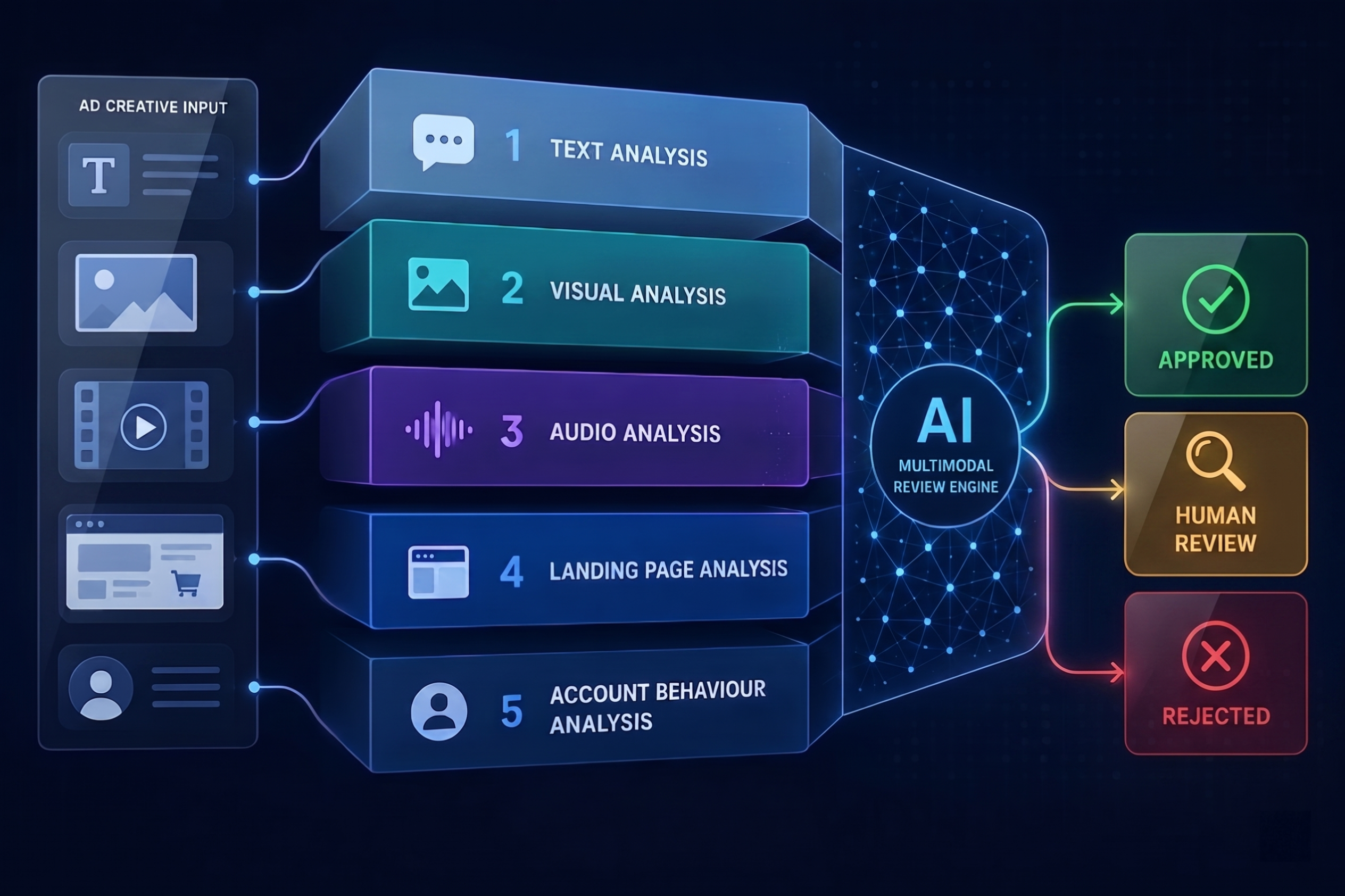
The most significant technical leap in this update is the ability of the AI to "think" multimodally. Previously, Meta’s bots reviewed text, images, and videos in silos. MARS breaks these walls down, analysing five distinct data layers in near real-time, typically within seconds to under a minute during the initial review phase.
Text Analysis
Ad copy, headlines, and descriptions are assessed using natural language processing that goes beyond keyword matching. Synonyms, euphemisms, and indirect phrasing are analysed for semantic intent. A phrase like "clinically shown" is evaluated with the same scrutiny as "guaranteed."
Visual Analysis
Computer vision scans images and video frames for content that signals policy risk — before/after imagery, medical or clinical visuals, financial performance charts, and Housing/Employment/Credit (HEC) category signals — even when the ad copy contains no flagged terms.
Audio Analysis
For video ads, speech-to-text transcription and sentiment analysis are applied to the audio track. Claims made verbally in a voiceover are held to the same policy standard as written copy. This closes a significant gap that previously allowed verbal claims to go undetected.
Landing Page Analysis
Meta now evaluates the ad and its destination URL as a single unit. The system performs real-time crawling of landing pages to check for consistency between ad claims and on-page content. Mismatches, such as "Free shipping" in the ad but minimum purchase requirements on the landing page, are treated as policy violations.
Account Behaviour Analysis
An account's compliance history, operational patterns, IP behaviour, and device activity are factored into the risk assessment. Accounts with patterns that resemble coordinated inauthentic behaviour face heightened scrutiny, regardless of individual ad content.
After the multimodal review is completed, ads generally fall into three possible states:
-
Approved (under 60s): If no policy risks are detected, the ad is approved and begins delivery almost immediately. In most cases, this happens within seconds to under a minute.
-
Limited Delivery / Sent to Further Review
If the system detects ambiguous signals or borderline policy risks, the ad may be flagged for additional review.
This can involve: -
Secondary AI validation layers
-
Human reviewer intervention
Review time can vary widely depending on queue volume and risk level, but typically ranges from several hours up to 48-72 hours, and in complex cases may extend longer.
-
Rejected
If clear policy violations are identified during the initial scan, the ad is rejected immediately. The account may also receive a policy strike depending on severity and historical behaviour.
Three Policy Pillars Driving 2026 Enforcement
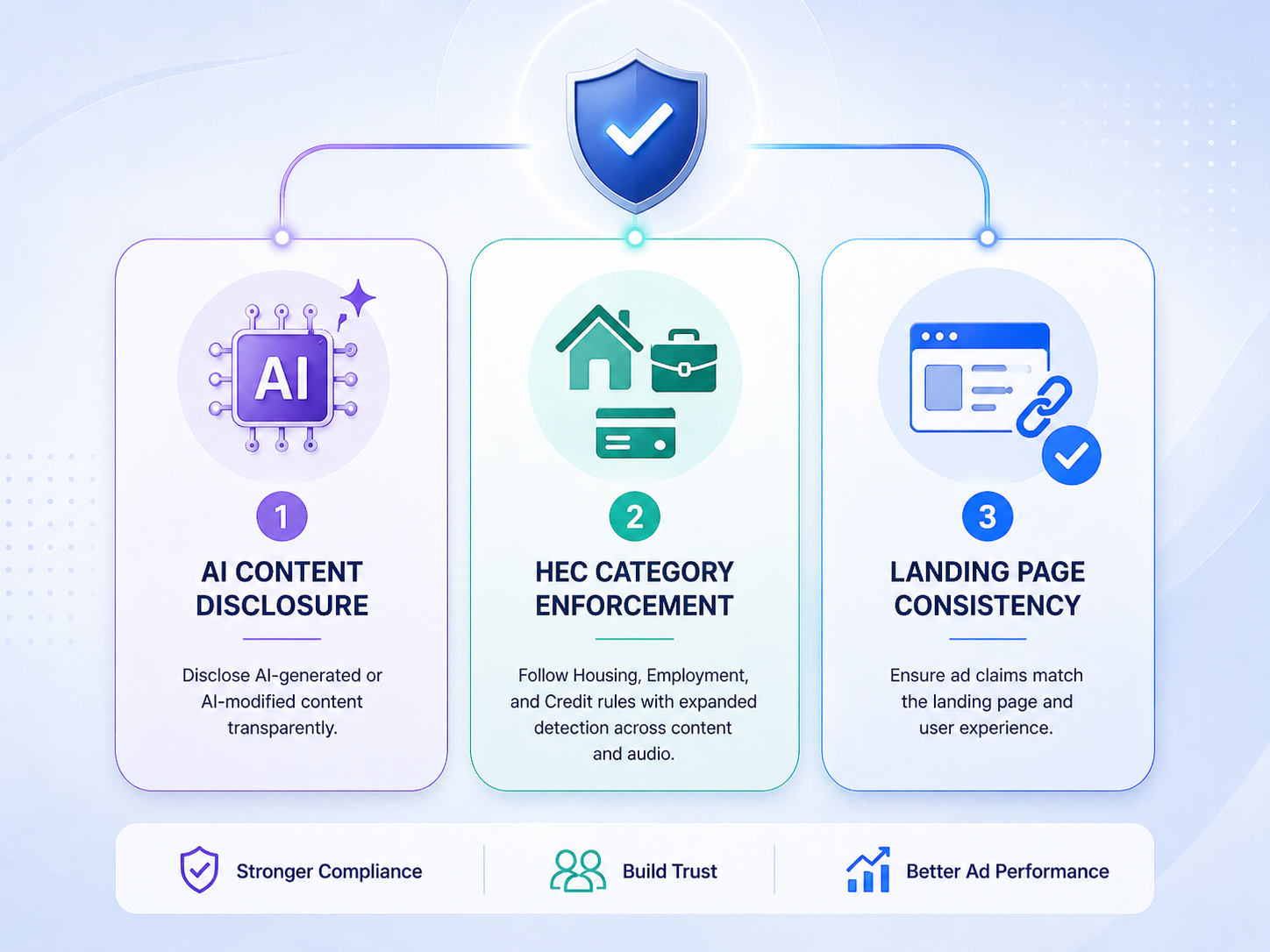
To navigate the complexities of the MARS update, advertisers must align with three foundational pillars that now dictate Meta’s enforcement logic. These pillars are not merely guidelines but integrated technical barriers designed to filter out low-quality or deceptive content before it reaches the end-user.
1. Mandatory AI Content Disclosure
Meta has implemented global requirements for advertising that uses AI-generated or AI-substantially-modified creative content. Any ad where AI tools were used to generate product imagery, replace backgrounds, modify faces or bodies beyond standard filters, create synthetic voiceovers, or produce AI-generated video must carry an 'AI-generated' label, applied via a checkbox in Ads Manager during campaign creation.
Meta's enforcement systems actively check for C2PA metadata from tools including DALL-E, Midjourney, and Stable Diffusion, and run visual analysis to detect synthetic artefacts. If AI content is detected that was not disclosed by the advertiser, the ad is rejected, and the account receives a policy strike.
Note: Meta's own Advantage+ Creative system, which generates ad variations automatically, is exempt from manual disclosure requirements. Meta handles that labelling internally. The disclosure obligation applies to creatives uploaded directly by advertisers.
2. Expanded HEC Special Ad Category Enforcement
Detection of Housing, Employment, and Credit (HEC) category content has moved from keyword-based flagging to a multimodal detection pipeline. Computer vision now scans for visual signals — floor plans, office environments, credit card imagery, loan application forms — and audio signals in video ads. Advertisers can no longer bypass HEC restrictions by avoiding certain keywords if the visual or audio content triggers HEC classification.
The scope of the Credit category has also been extended to include Buy Now Pay Later (BNPL) products and crypto lending platforms. E-commerce brands that have historically promoted BNPL options as a standard checkout feature without HEC classification must now update their campaign setup.
3. Landing Page and Claim Consistency
Ad content and landing page content are now evaluated as a unified compliance unit. Advertisers should audit not only their ad creative but the full destination experience, including headlines, pricing, offer terms, and any performance claims, for consistency with what is stated in the ad.
Which Verticals Are Most Affected?
Based on advertiser-reported data aggregated across compliance monitoring platforms in Q1 2026, the following industries are experiencing the most significant enforcement friction:
-
Health, wellness & beauty: The combination of semantic intent detection and stricter visual analysis has substantially increased rejection rates. Before/after imagery, transformation claims, and language that implies personal health conditions are the primary triggers.
-
E-commerce and DTC brands: AI-generated product renders, lifestyle imagery created with generative tools, and synthetic model visuals that were not previously disclosed are now causing rejections at submission.
-
Finance and fintech: BNPL advertisers must now operate under HEC Special Ad Category restrictions. Crypto lending platforms face the same classification requirements.
-
Real estate and recruiting: Visual content detection means that floor plans, property photos, and office imagery in ads automatically trigger HEC restrictions, regardless of the ad copy used.
What Should Agencies Do?
The following actions address the highest-risk compliance gaps created by the March 2026 enforcement changes:
-
Audit all AI-generated creative assets in active and upcoming campaigns. Apply the AI disclosure label in Meta Ads Manager to any creative where generative AI tools were used to produce or substantially alter visual or audio elements.
-
Review landing page claims against ad copy for every active campaign. Any offer, pricing claim, shipping promise, or performance statement that appears in the ad must be accurately reflected on the destination page.
-
Replace before/after imagery in health, wellness, and supplement campaigns unless the transformation claim is backed by published clinical evidence. Implied transformation claims are now enforced at the same level as explicit guarantees.
-
Review ad copy for second-person language that implies knowledge of a user's personal condition. Phrasing such as 'For people managing blood sugar' is treated as a personal attributes violation. Reframe to benefit-led language: 'Supports healthy glucose metabolism.'
-
For video ads, audit voiceover scripts with the same rigour as written copy. Any performance claim made verbally is now subject to the same enforcement standards as headline copy.
-
Monitor Account Health Score in Meta Ads Manager on a regular basis. Accounts with degraded scores face slower review times and, at the lower end of the scale, restricted ad delivery. Proactive monitoring provides early warning before restrictions affect campaign performance.
-
For BNPL and crypto lending clients, update campaign settings to the Credit Special Ad Category immediately if this has not already been done. Running without the correct category classification now constitutes an active policy violation.

The March 2026 update is a clear signal that Meta is prioritising quality over quantity. In the age of MARS, the most successful advertisers will be those who treat compliance as a core part of their creative strategy rather than an afterthought.