
The video game market is no longer driven by novelty or hype alone. Today, thousands of games compete for the same attention across mobile stores, PC platforms, consoles, and social channels. Discovery is fragmented, acquisition costs continue to rise, and players are more selective than ever. In this environment, a strong game alone is not enough. Without a structured and data-driven marketing strategy, even high-quality titles struggle to gain traction.
Video game marketing has evolved from simple promotion into a full growth system that spans user acquisition, retention, community building, and long-term monetization. For marketers who already understand paid advertising and performance channels, the real challenge is not learning new tools, but aligning marketing execution with the game’s lifecycle, audience behavior, and economic model.
This guide breaks down the most effective video game marketing strategies used today, explains how to build a practical game marketing plan, and highlights common mistakes that limit growth. The focus is on execution, scalability, and measurable outcomes, not surface-level tactics.
The Importance of Video Game Marketing
In the current landscape, marketing isn't an afterthought; it is a core component of the product lifecycle. With the rising costs of user acquisition (UA) and the deprecation of traditional tracking identifiers, simply "buying users" is no longer a viable long-term strategy.
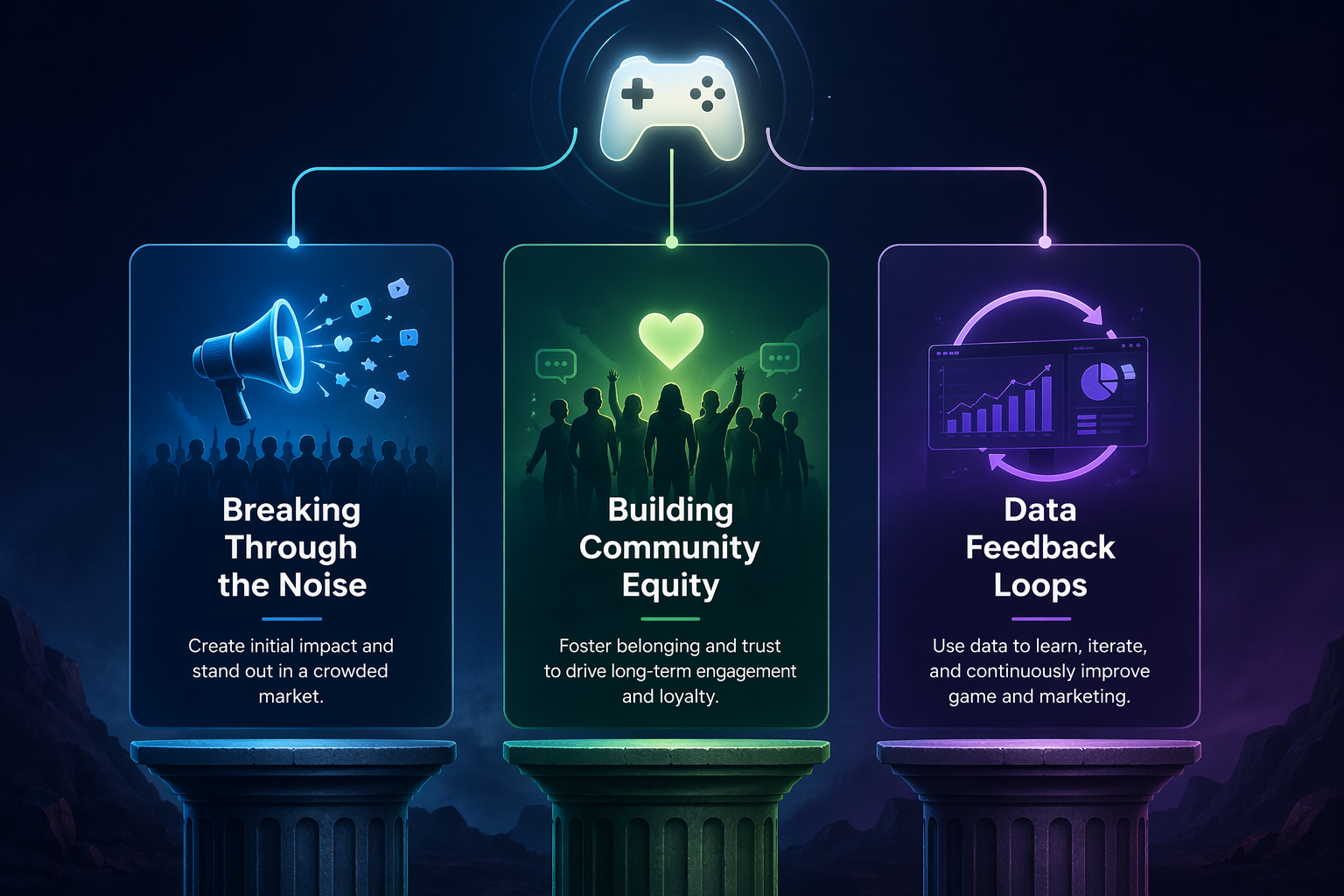
Effective marketing serves three critical functions:
-
Breaking Through the Noise: The sheer volume of content means organic discovery is a myth for most developers. Marketing creates the initial "velocity" required to trigger platform algorithms.
-
Building Community Equity: Unlike one-off consumer goods, games thrive on LTV (Lifetime Value). Marketing fosters the community that sustains a game for years.
-
Data Feedback Loops: High-level marketing provides the data necessary to refine gameplay loops, monetization hooks, and retention mechanics before a global scale-up.
Most Effective Strategies for Video Game Marketing
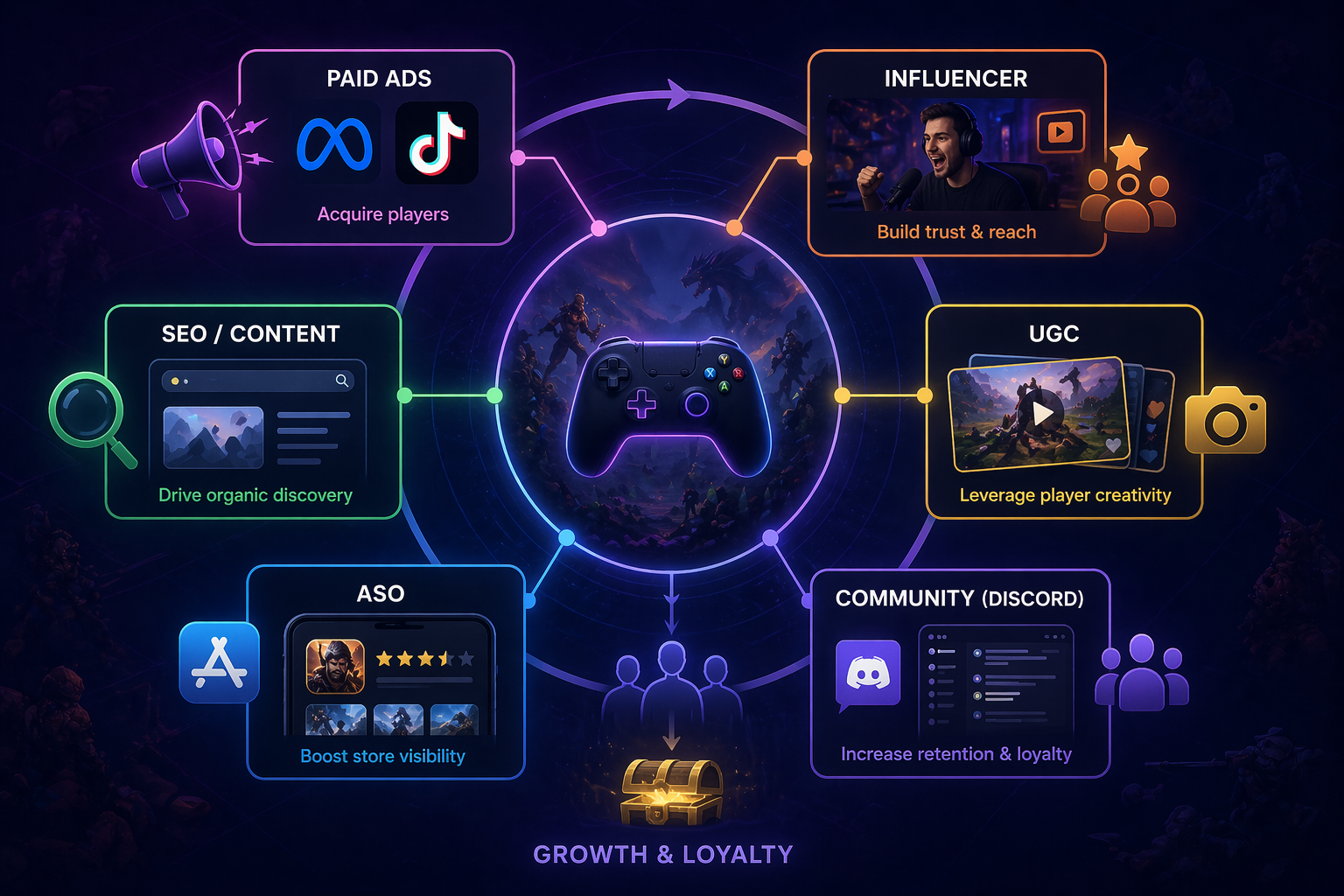
To move the needle in 2026, you need a multi-channel approach that balances paid performance with organic growth. Here are the pillars of a modern gaming marketing stack.
Cross-promotion
Cross-promotion remains one of the most cost-effective ways to acquire high-quality users. If you have an existing portfolio of games, leveraging your current user base to bootstrap a new title reduces UA costs significantly. Use "house ads" or interstitial rewards to move players from an older title to your new launch, ensuring the genres align to maintain high conversion rates.
Specialized Promotional Programs
Beyond standard ad networks, look for specialized gaming platforms that offer incentivized discovery or community-based matchmaking. These programs allow you to target "power users"—players who are statistically more likely to engage in in-app purchases or provide high-quality feedback. By integrating with platforms where gamers already hang out to find teammates, you bypass the friction of traditional banner ads.
Influencer Partnerships
The shift in influencer marketing has moved from "mega-celebrities" to "micro-niche experts." For a successful campaign, prioritize streamers and content creators who have high engagement within your specific sub-genre (e.g., 4X strategy or extraction shooters).
-
Performance-based deals: Move beyond flat fees. Structure deals with a base pay plus a bonus based on trackable installs or milestone completions.
-
Twitch/YouTube Integration: Use "Drops" or interactive overlays that allow viewers to influence the streamer's game in real-time.
Social Media Engagement
Static posts are dead. In 2026, social media for gaming is about vertical video (TikTok, Reels, Shorts) and community hubs (Discord).
-
The "Behind the Scenes" Hook: Show the dev process, bugs-turned-features, and concept art to build emotional investment.
-
Rapid Response: Use social listening tools to jump on trending memes or industry news, positioning your game’s brand as part of the cultural conversation.
Search Engine Optimization (SEO)
SEO for games is often overlooked but vital for long-term organic growth. Focus on:
-
Keyword Intent: Target "Best [Genre] games 2026" or "Games like [Popular Competitor]."
-
Wiki & Guide Content: Create a comprehensive "Game Wiki." New players often search for "How to beat [Level]" or "Best builds for [Character]." If your site hosts these answers, you capture the traffic instead of a third-party site.
Content Marketing
Your content should solve a problem or provide entertainment. High-quality cinematic trailers are great for hype, but "Dev Diaries" and "Patch Note Breakdowns" are what keep a community loyal. Content marketing should focus on the lore and the mechanics, giving players a reason to care about the world you’ve built.
User-Generated Content (UGC)
UGC is the most powerful social proof available. Encourage your players to share their "clutch moments" or creative builds.
-
In-game sharing tools: Make it a one-click process to export a replay or a screenshot to social media.
-
Contests: Run weekly challenges where the best player-created content wins in-game currency or exclusive skins.
App Store Optimization (ASO)
ASO is the SEO of the mobile world. Your conversion rate (CVR) on the store page dictates your CPI (Cost Per Install).
-
A/B Testing: Constantly test your icon, screenshots, and first 10 seconds of your preview video.
-
Localization: Don't just translate text; localize the visuals. What appeals to a player in the US might not resonate in the SEA or MENA regions.
How to Create a Game Marketing Plan for a Successful Launch
A successful launch isn't an accident; it's a choreographed sequence of events. Use this step-by-step framework to build your launch board.
How to Write a Game Marketing Plan
1. Define the Game’s Identity
Before spending a dollar, you must know what your game is and what it isn't. Identify your "Unique Selling Proposition" (USP).
-
Action: Create a visual mood board that captures the art style, tone, and core mechanic. Use a template to define your "Elevator Pitch" in 30 words or less.
2. Understand Your Audience
Who is your "Whale"? Who is your "F2P Grinder"?
-
Action: Create personas based on player motivations (e.g., Socializers, Achievers, Explorers). Map out where these people spend their time online.
3. Position Your Game in the Market
Analyze your top 5 competitors. What are they missing?
-
Action: Create a competitive matrix. If the market leader is "Complex but Grindy," perhaps your position is "Deep but Accessible."
4. Set Clear Goals
Vague goals lead to wasted budgets.
-
Action: Use "Note Cards" to set KPIs for Day 1 Retention (D1), Day 7 (D7), and Target ROAS. Define what "Success" looks like for the soft launch vs. global launch.
5. Plan Your Launch Strategy
Break your launch into three phases: Pre-heat, Launch Week, and Sustain.
-
Action: Create a to-do list for each phase. Include milestones like "Trailer 1 Reveal," "Pre-registration Open," and "Day 0 Patch."
6. Choose the Right Promotion Channels
Not every game needs to be on every platform.
-
Action: Select 3 primary channels (e.g., Meta Ads for UA, TikTok for Virality, Discord for Retention) and master them before expanding.
7. Allocate a Budget
Split your budget: 60% for UA, 20% for Content Creation (Trailers/Assets), and 20% for "Experimental" (Influencers/New Platforms).
-
Note: Always keep a 10% "War Chest" for unexpected opportunities or to double down on a winning creative.
8. Organize & Refine
A plan is a living document.
-
Action: Use a kanban-style board to track the production of creative assets. If a certain ad format is underperforming, move it to the "Kill" column and pivot.
9. Gather Feedback
Internal echoes are dangerous.
-
Action: Invite external "Alpha Testers" or marketing consultants to review your plan. Use comment threads to debate the merits of specific taglines or key art.
10. Share the Plan with Your Team
Alignment is key. Ensure your developers know what the marketing team is promising so the game actually delivers.
-
Action: Share a read-only link with stakeholders to ensure everyone is moving toward the same North Star.
Common Mistakes in Video Game Marketing Strategies
Even with a massive budget, these four pitfalls can sink a promising title.
Over-reliance on Influencers
Influencers are great for a "spike" in traffic, but they are rarely a sustainable source of long-term UA. If your game doesn't have an inherent "viral loop," the users brought in by an influencer will churn as soon as the streamer moves on to the next game. Treat influencers as a top-of-funnel awareness tool, not your entire strategy.
Scaling Paid Ads Too Early
Many marketers make the mistake of scaling spend before they have hit their retention benchmarks. If your D1 retention is below 35-40% (depending on the genre), scaling ads is just "pouring water into a leaky bucket." Fix the product-market fit in a soft launch before opening the floodgates.
Ignoring Retention and Monetization Alignment
Marketing often stops at the "Install." However, in modern gaming, the marketing team must work with game designers to ensure the "Ad Creative" matches the "Game Experience." If you use "fake gameplay" ads that don't reflect the actual game, your D1 retention will plummet, and your store rating will suffer.
Treating Launch as a One-Time Event
A "Launch" is a season, not a day. Many teams spend 90% of their budget on Week 1 and have nothing left for the "Sustain" phase. In reality, your game will likely find its true audience 3–6 months after launch through iterative updates and consistent live-ops marketing.
FAQs
How much should I spend on a soft launch?
A soft launch budget should be just enough to get statistically significant data (usually 1,000–5,000 installs per tier-1 country). The goal here is learning, not profit.
Should I focus on Meta or TikTok for UA?
Meta (Facebook/Instagram) remains the king of "Precise Targeting," while TikTok is superior for "Viral Reach" and lower CPMs. Most successful campaigns use a 70/30 split, favoring Meta for stable scaling and TikTok for creative experimentation.
How long should game marketing start before launch?
Most successful campaigns begin several months before launch to validate positioning, build awareness, and collect early feedback.
Is paid advertising necessary for all games?
Not always, but paid channels provide scalability and speed. The key is using them strategically, not indiscriminately.
What metrics matter most in game marketing?
Retention, lifetime value, and acquisition efficiency are more important than raw installs or impressions.
Can indie games compete without large budgets?
Yes, through focused positioning, community engagement, and disciplined channel selection.
Read more: