
In the professional services sector—whether you are scaling a consultancy, a law firm, or a specialized financial agency—the gap between "visibility" and "revenue" has never been wider. Gone are the days when a slick website and a few generic blog posts sufficed. For performance-minded marketers and agency owners, the challenge in 2026 is no longer just about generating traffic; it is about engineering a high-intent pipeline that survives the scrutiny of sophisticated B2B buyers.
This guide moves beyond surface-level advice to provide a strategic marketing framework designed for those who understand the mechanics of ads, attribution, and ROI.
Building a Strategic Foundation for Professional Services Marketing
A strategic marketing framework for professional services fails when it's built on vanity metrics. To capture high-value contracts, your foundation must be engineered to align marketing spend directly with Pipeline Velocity.
Defining Your Ideal Client Profile (ICP)
Forget broad personas. In B2B professional services, your ideal client profile (B2B) should be a "Target Account List" defined by firmographic targeting and technographic data:
-
Industry Verticals: Focus on "Micro-Niches" (e.g., Cybersecurity Compliance for Fintech instead of just IT Consulting).
-
Revenue Size & Funding Stage: Target firms at "Inflection Points"—Series B funding, M&A transitions, or regulatory shifts.
-
Decision-Maker Roles: Map the Economic Buyer (CFO), the Champion (VP of Ops), and the Influencer (External Consultants).
Competitive Positioning and Differentiation
Your value proposition in professional services must solve the "Commodity Trap."
-
Category Leadership: Move from "We provide legal advice" to "We are the architects of IP protection for AI startups."
-
Pricing Positioning Models: Use Performance-Based Pricing or Tiered Retainers to signal confidence in results, separating you from "hourly rate" competitors.
-
Specialized Positioning: Leverage the Expert’s Curse—the more specific the problem you solve, the higher the premium you command.
Setting Revenue-Aligned Marketing Goals
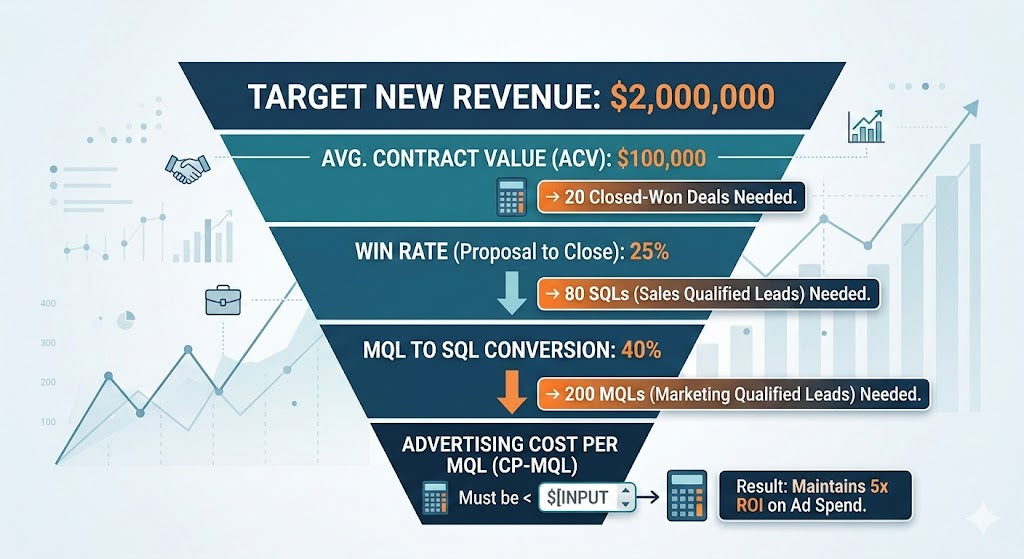
A revenue-driven marketing strategy requires a math-based marketing ROI framework. Stop reporting on "leads" and start reporting on Marketing Qualified Pipeline (MQP).
The Revenue Back-Calculated Formula:
-
Target New Revenue: $2M
-
Avg. Contract Value (ACV): $100k → Need 20 Closed-Won Deals.
-
Win Rate (Proposal to Close): 25% → Need 80 SQLs (Sales Qualified Leads).
-
MQL to SQL Conversion: 40% → Need 200 MQLs (Marketing Qualified Leads).
-
Cost Per MQL (CP-MQL): Must be $<X$ to maintain a 5x ROI on ad spend.
SEO Strategy for Professional Services Firms
SEO for professional services in 2026 is no longer about keyword stuffing; it’s about Entity Authority. Google and AI search engines (GEO/AEO) now prioritize sites that prove they are the "Source of Truth" for specific complex topics.
High-Intent Keyword Targeting
Shift your focus from "Information Intent" (What is...) to "Investigative & Commercial Intent":
-
Comparison Keywords: "[Competitor A] vs [Your Firm] for [Specific Use Case]".
-
Cost-Related Keywords: "Cost of outsourcing [Service] vs In-house" – this captures buyers in the evaluation stage.
-
Problem + Solution Combinations: "How to navigate [New Regulation 2026] for [Industry]".
Pillar Pages and Topic Clusters
Organize your site using a Content Hub Architecture.
-
The Pillar: A 3,000+ word "Ultimate Guide" that defines the category.
-
The Clusters: 5-10 sub-articles answering specific technical hurdles, all internally linking back to the Pillar with descriptive anchor text.
-
Landing Page Optimization: Ensure your industry-specific pages aren't just mirrors of each other; they must address the unique jargon and pain points of that sector.
E-E-A-T and Trust Optimization
For "Your Money Your Life" (YMYL) services, authority building SEO is mandatory.
-
Author Transparency: Use Schema.org/Person markup to link authors to their LinkedIn profiles, published books, or speaking engagements.
-
Trust Signals: Embed real-time data or API-driven "Success Counters" (e.g., "Total Capital Managed" or "Active Cases").
-
Structured Data: Deploy FAQ Schema to win Featured Snippets and Review Schema to show star ratings directly in SERPs.
Paid Media Strategy for Professional Services Marketing
If you understand Ads, you know that professional services lead generation is a game of "Signal vs. Noise." Your paid strategy should focus on capturing existing intent (Google) and creating new intent (LinkedIn).
LinkedIn Ads and Account-Based Marketing (ABM)
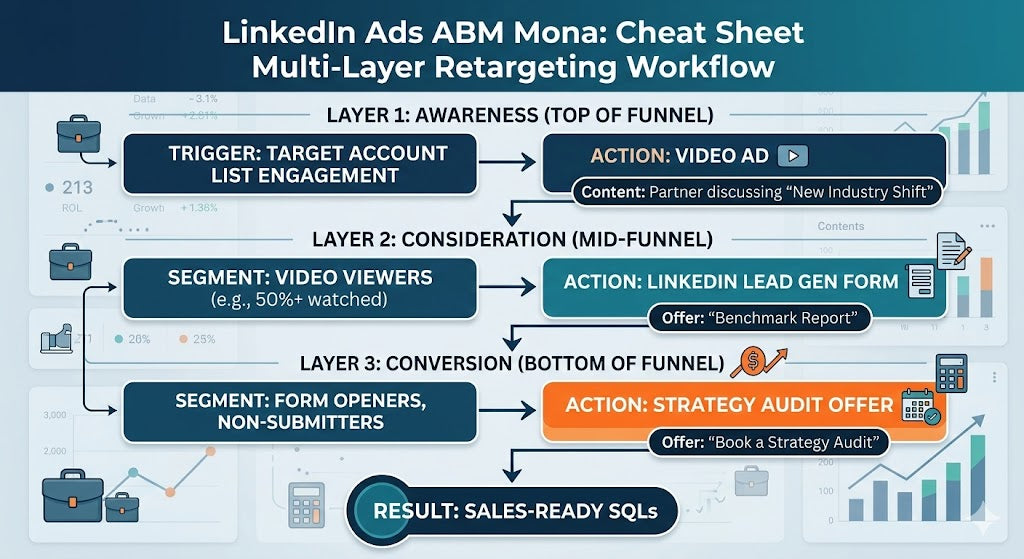
Don't just "boost posts." Use ABM retargeting workflows:
-
Layer 1 (Awareness): Video ads featuring a partner discussing a "New Industry Shift."
-
Layer 2 (Consideration): Retarget video viewers with a "Benchmark Report" using LinkedIn Lead Gen Forms.
-
Layer 3 (Conversion): Retarget form openers who didn't submit with a direct "Strategy Audit" offer.
Google Search and High-Intent Campaigns
In Google Ads for consulting firms, the "Negative Keyword" list is as important as the target list.
-
Aggressive Competitor Bidding: Bid on competitor brand names + "alternatives" or "reviews."
-
Dynamic Search Ads (DSA): Use DSAs to catch long-tail queries your manual keyword research missed.
-
Conversion Tracking: Move beyond "Form Fills." Track "High-Value Page Views" (Pricing, Team) as micro-conversions.
Retargeting and Multi-Touch Attribution
The B2B path to purchase is rarely linear.
-
Cross-Channel Retargeting: If they clicked a LinkedIn ad, show them a Google Display ad with a client testimonial.
-
Lookalike Audiences: Upload your CRM data of "Closed-Won" clients to find mirror audiences on Meta and LinkedIn.
-
Attribution Model: Use "Position-Based" (U-Shaped) attribution to give credit to the first touch (Discovery) and the last touch (Conversion).
Content Marketing and Thought Leadership
Thought leadership marketing strategy is your "Salesperson that never sleeps." In professional services, content is the proxy for the actual service experience.
Research-Based Content Assets
Stop re-summarizing news. Original Research is the only content that earns high-quality backlinks in 2026.
-
Proprietary Data: If you’re a financial firm, anonymize your data to show "Spending Trends in SaaS for 2026."
-
Benchmark Studies: Create a "Maturity Model" where prospects can score themselves—this provides you with qualifying data before the first call.
Case Studies and Social Proof
Transform "Testimonials" into ROI Case Breakdowns.
-
The Framework: Situation -> Complication -> Solution -> Quantified Impact (e.g., "Reduced tax liability by 18%").
-
Logical Social Proof: Use "Logos" of recognized companies, but back them up with deep-dive technical interviews.
Common Mistakes in Professional Services Marketing
Even with high ad spend, many firms fail to see ROI due to systemic execution gaps. For performance-minded marketers, identifying these "budget killers" is the first step toward a high-efficiency pipeline.
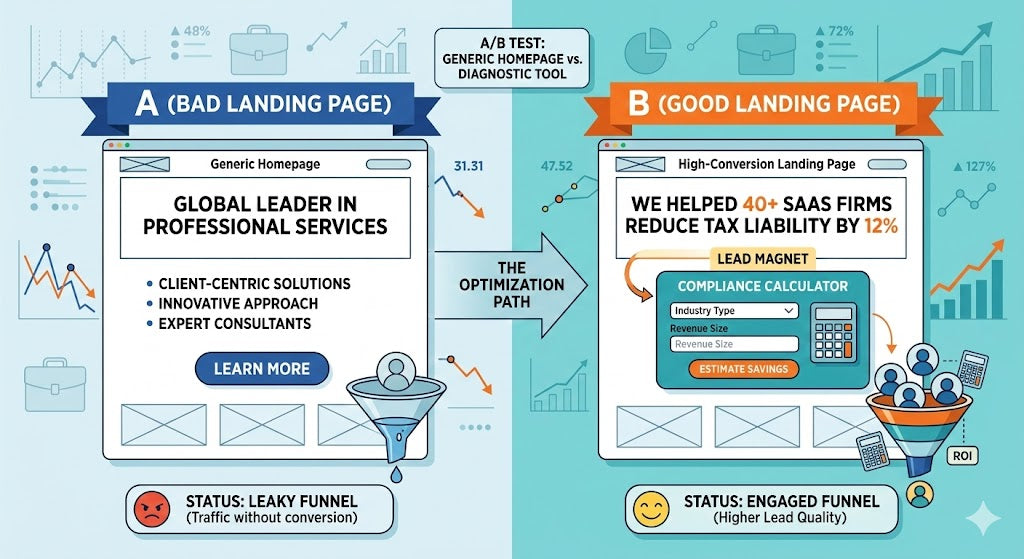
The "Leaky Funnel" Syndrome: Traffic Without Infrastructure
Driving high-intent traffic from Google or LinkedIn Ads to a generic homepage is a common way to waste budget. If your landing page lacks a specific conversion path, you are essentially subsidizing Big Tech.
-
The Gap: High bounce rates due to vague "Contact Us" CTAs and slow loading speeds.
-
The Fix: Deploy dedicated landing pages with low-friction offers (e.g., a "15-minute Audit" or "Price Calculator") to bridge the gap between curiosity and commitment.
Over-reliance on "Vague" Messaging
B2B buyers in legal or financial sectors have a high "cringe factor" for corporate jargon like "Global Leader" or "Innovative Solutions." * The Gap: Messaging that is indistinguishable from competitors leads to the "Commodity Trap," where you can only compete on price.
-
The Fix: Use Data-backed Messaging. Replace "We are experts" with "We helped 40+ SaaS firms reduce tax liability by 12%." Specificity creates authority.
Neglecting "Dark Social" and Attribution Illusions
Performance marketers often over-optimize for what they see in a dashboard (Last-click), ignoring the "Dark Social" impact—private Slack groups, peer referrals, and offline word-of-mouth.
-
The Gap: Undervaluing top-of-funnel activities (podcasts, original research) because they don't show an immediate "click."
-
The Fix: Use a Hybrid Attribution model. Combine digital tracking with a mandatory "How did you hear about us?" field on your lead forms to capture the true source of high-value leads.
The "One-and-Done" Content Mentality
Treating a whitepaper or a report as a single checklist item is a waste of intellectual capital.
-
The Gap: Most prospects require 7-10 touchpoints. A single post or ad is not a strategy.
-
The Fix: Atomize your content. Turn one industry report into 10 LinkedIn posts, 5 short-form videos, and a retargeting ad sequence. Stay top-of-mind throughout the 6-month sales cycle.
FAQs About Professional Services Marketing
How do we balance "Brand" vs "Performance" in professional services?
In professional services, your brand is your performance. Every ad should educate (Brand) while offering a clear next step (Performance). A 60/40 split in the budget in favor of high-intent search and ABM is standard for growth-stage firms.
What is the most effective Lead Magnet for 2026?
Interactive tools. A "Compliance Calculator" or "ROI Projector" generates 3x more high-intent leads than a static PDF Whitepaper because it provides immediate value.
Does SEO still matter if most of our business is referrals?
Yes. Referrals don't just call you; they Google you first. If your SEO/Content doesn't validate the referral's recommendation, you lose the deal before it starts.
How is professional services marketing different from product marketing?
Professional services marketing emphasizes trust, expertise, and long-term relationships. It relies more heavily on authority, case studies, and thought leadership due to the intangible nature of services and longer buying cycles.
What are the best marketing channels for professional services firms?
High-performing channels typically include:
-
SEO for high-intent keywords
-
LinkedIn Ads for targeted B2B outreach
-
Google Search campaigns
-
Thought leadership content and webinars
Channel selection should align with deal size and sales cycle length.