
The food and lifestyle category is one of the most competitive and margin-sensitive environments in digital advertising. Unlike SaaS or high-ticket ecommerce, you are often working with lower AOV, higher purchase frequency, short consideration cycles, and intense visual competition across paid social feeds.
If you are running ads in this space, you already know that basic tactics do not scale. Creative fatigue hits fast. Discounts erode margin. Retail distribution complicates attribution. Consumer loyalty is fragile.
This guide breaks down Food & Lifestyle Marketing Strategies through a performance lens. It synthesizes trend-based thinking, consumer psychology, retail complexity, and paid media execution frameworks.
Advanced Food & Lifestyle Marketing Strategies
To outperform the competition, you need a multi-layered approach that addresses the consumer’s psychology while maintaining technical excellence in your ad accounts. Here are 14 sophisticated strategies to scale your brand.
1. Lifestyle-First Brand Positioning Strategy
Stop selling the product; sell the outcome. This involves creating a "World of the Brand." If you are selling an espresso machine, don't just show the gears and steam. Show the quiet, sun-drenched morning, the ceramic mug, and the feeling of a slow start to a productive day. Identity alignment ensures that when a consumer thinks of their morning routine, they think of your brand.
2. Audience Segmentation by Motivation, Not Just Demographics
Age and gender are outdated metrics. Instead, segment by "jobs to be done."
-
The Biohacker: Looking for functional benefits (nootropics, protein).
-
The Aesthetic Seeker: Looking for "shelfie-worthy" packaging and status.
-
The Conscious Parent: Looking for "no-nasty" ingredients and convenience. Each of these segments requires unique copy angles and creative assets.
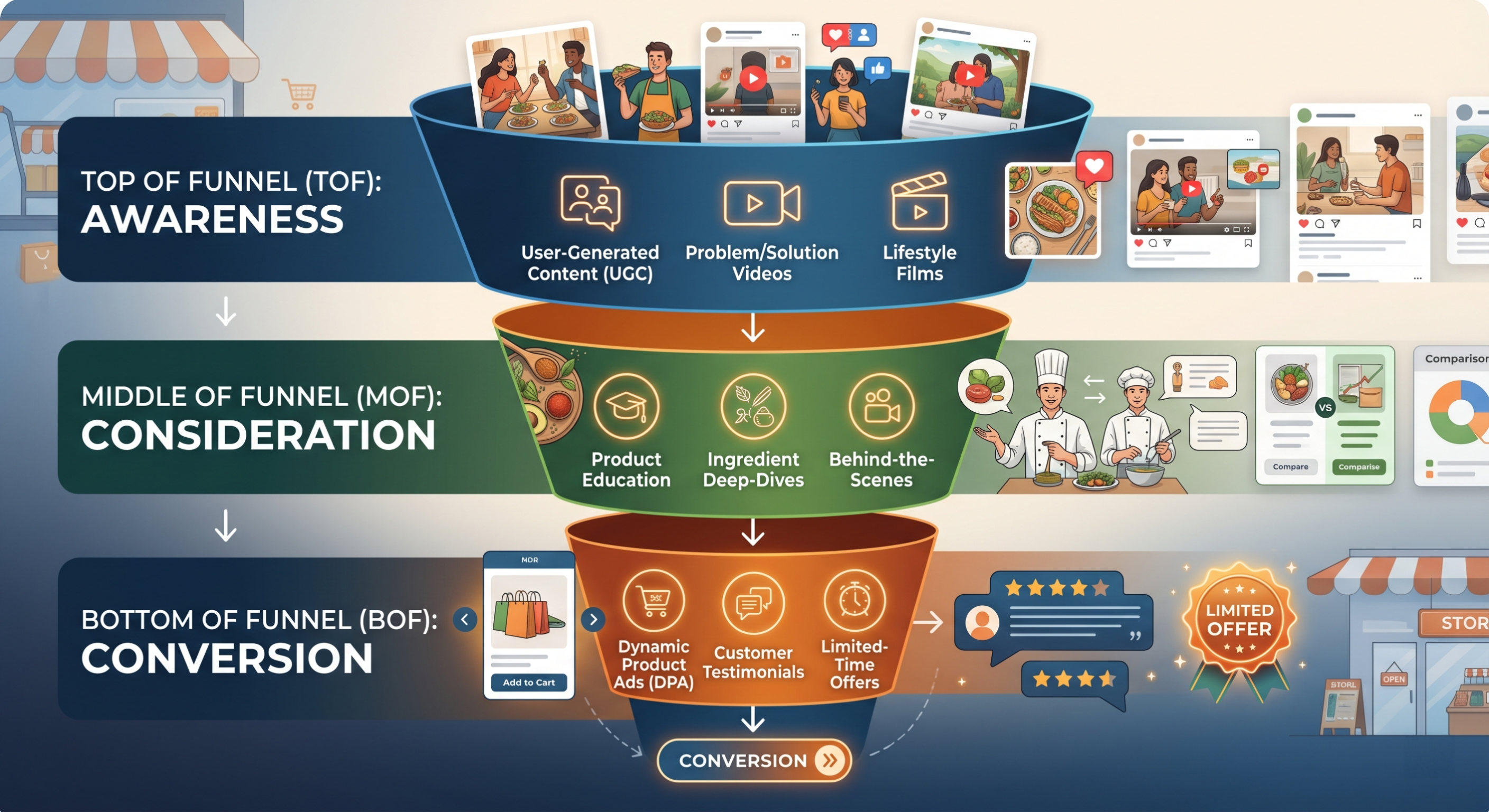
3. Full-Funnel Paid Media Architecture
A professional media buy on Meta or TikTok should look like this:
-
TOF (Top of Funnel): High-energy lifestyle films or "Problem/Solution" UGC to build awareness.
-
MOF (Middle of Funnel): Product education, ingredient deep-dives, or "How it’s Made" content to build trust.
-
BOF (Bottom of Funnel): Dynamic Product Ads (DPA), customer testimonials, and limited-time offers to close the sale.
4. Creative Cluster Testing and Fatigue Management
Food and lifestyle content fatigues faster than almost any other category. To combat this, use "Creative Clusters." Test one "Hook" (the first 3 seconds) against five different "Bodies" (the middle content). By isolating variables, you can find the winning combination without burning through your entire production budget.
5. UGC and Creator-Led Acquisition Systems
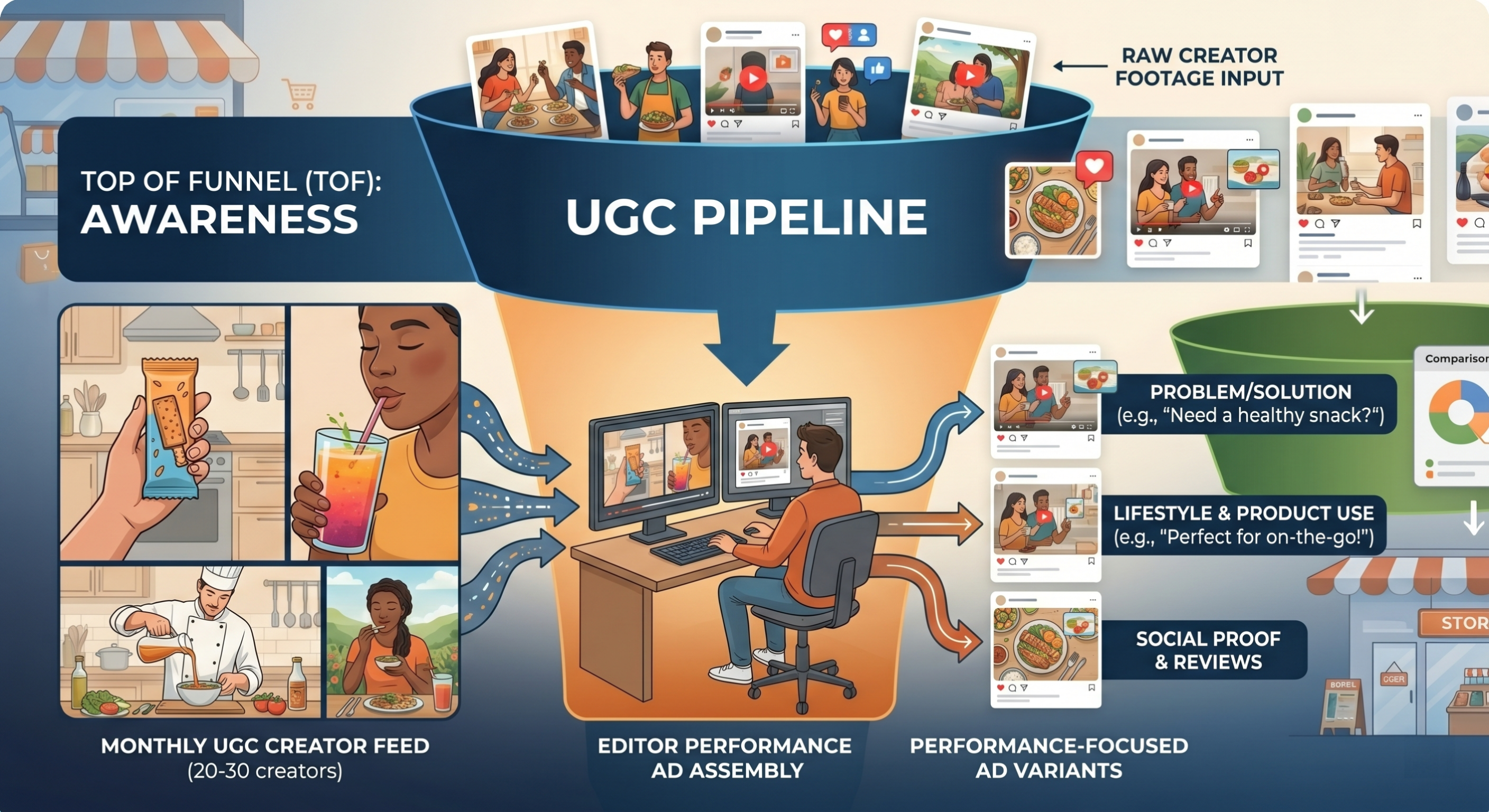
Static brand shots are dying. High-performing food & lifestyle ads examples usually feature "lo-fi" User-Generated Content (UGC). The key is building a pipeline. Instead of one-off influencer posts, create a system where 20-30 creators send you raw footage monthly, which your editors then turn into performance-focused ads.
6. Seasonal and Limited-Drop Campaign Engineering
Borrow a page from the "streetwear" playbook. Food brands can create massive surges in Demand Stacking by using limited-edition flavors or seasonal packaging. This creates "Fear Of Missing Out" (FOMO) and gives you a reason to re-engage your existing customer base without relying on a generic discount.
7. Retail Media and Marketplace Advertising Strategy
If your product is on Amazon or Instacart, your social ads should occasionally point there. Using "Storefront" links or "Add to Cart" integrations on platforms like Walmart Connect allows you to capture consumers where they are already doing their weekly shopping, reducing the friction of a new website sign-up.
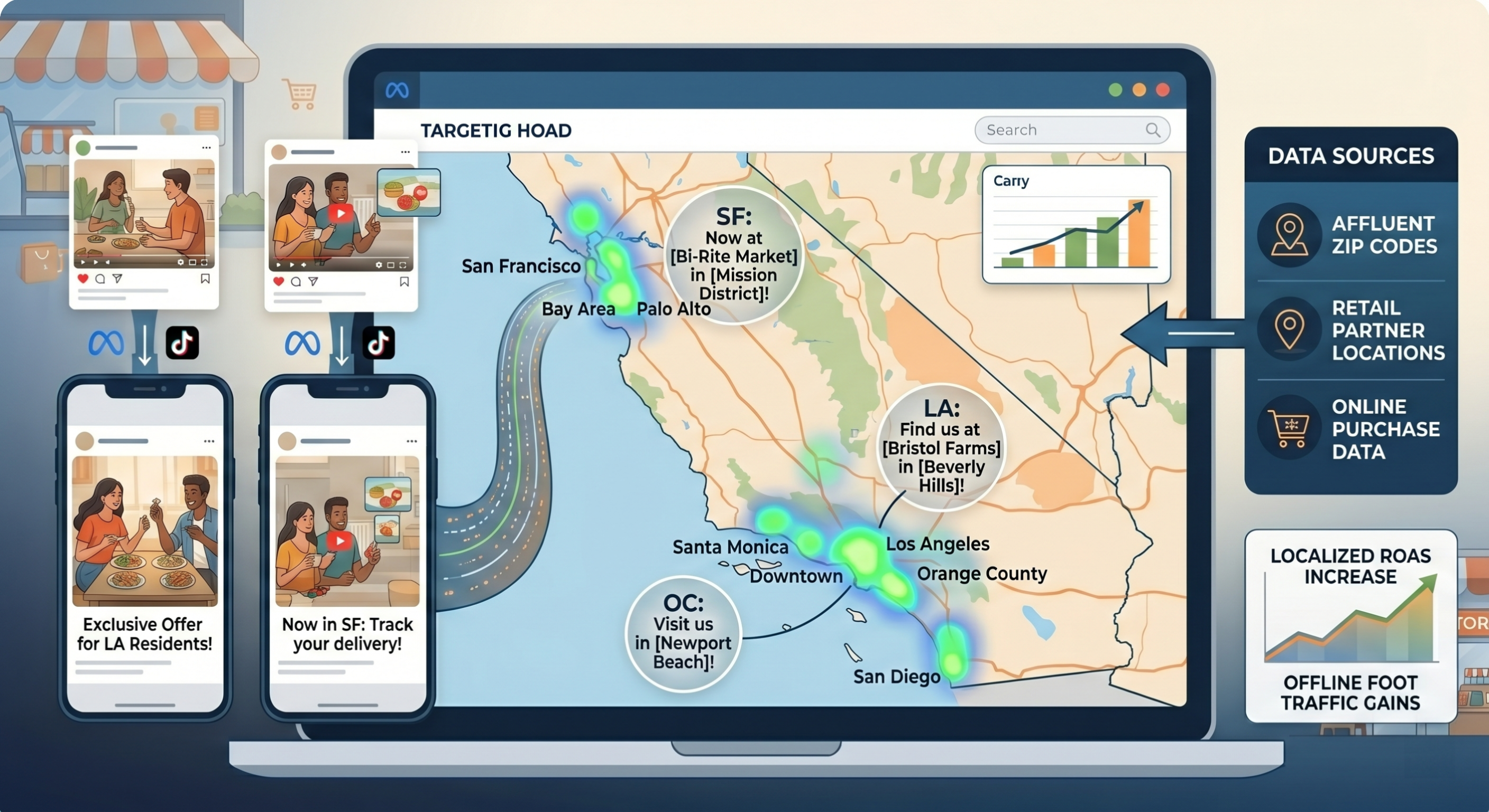
8. Geo-Targeted Expansion and Localization Models
Don't spray and pray. If you are a premium beverage brand, target high-income zip codes or cities with a high density of your retail partners. Use localized copy—"Now available at [Local Grocery Chain] in [City Name]"—to increase relevance and drive offline foot traffic via digital spend.
9. Data-Driven Product Development Feedback Loops
Your ad account is a focus group. If an ad featuring "Salted Caramel" has a 30% higher ROAS than "Vanilla Bean," that is a direct signal for your supply chain team. Use campaign data to decide which SKUs to kill and which to double down on.
10. Performance-Driven Content Marketing and SEO
In the food world, "Recipe SEO" is king. By owning keywords like "Easy keto breakfast ideas" or "Best dairy-free mocktails," you capture users at the high-intent research phase. This content serves as a low-cost entry point into your ecosystem, where you can then pixel them for retargeting.
11. Experiential and Offline-to-Online Amplification
Sampling is the oldest trick in the book, but the "New School" version uses QR codes. Every sample given at a pop-up should lead to a landing page where the user gets a discount in exchange for their email. This turns a "one-off taste" into a trackable digital lead.
12. Influencer Community Flywheel Systems
Move beyond "pay-per-post." Build a "Brand Ambassador" program where creators get a commission on sales and early access to new products. This creates a "flywheel" effect where their content becomes more authentic over time because they are genuine stakeholders in the brand's success.
13. Offer Structuring and AOV Optimization
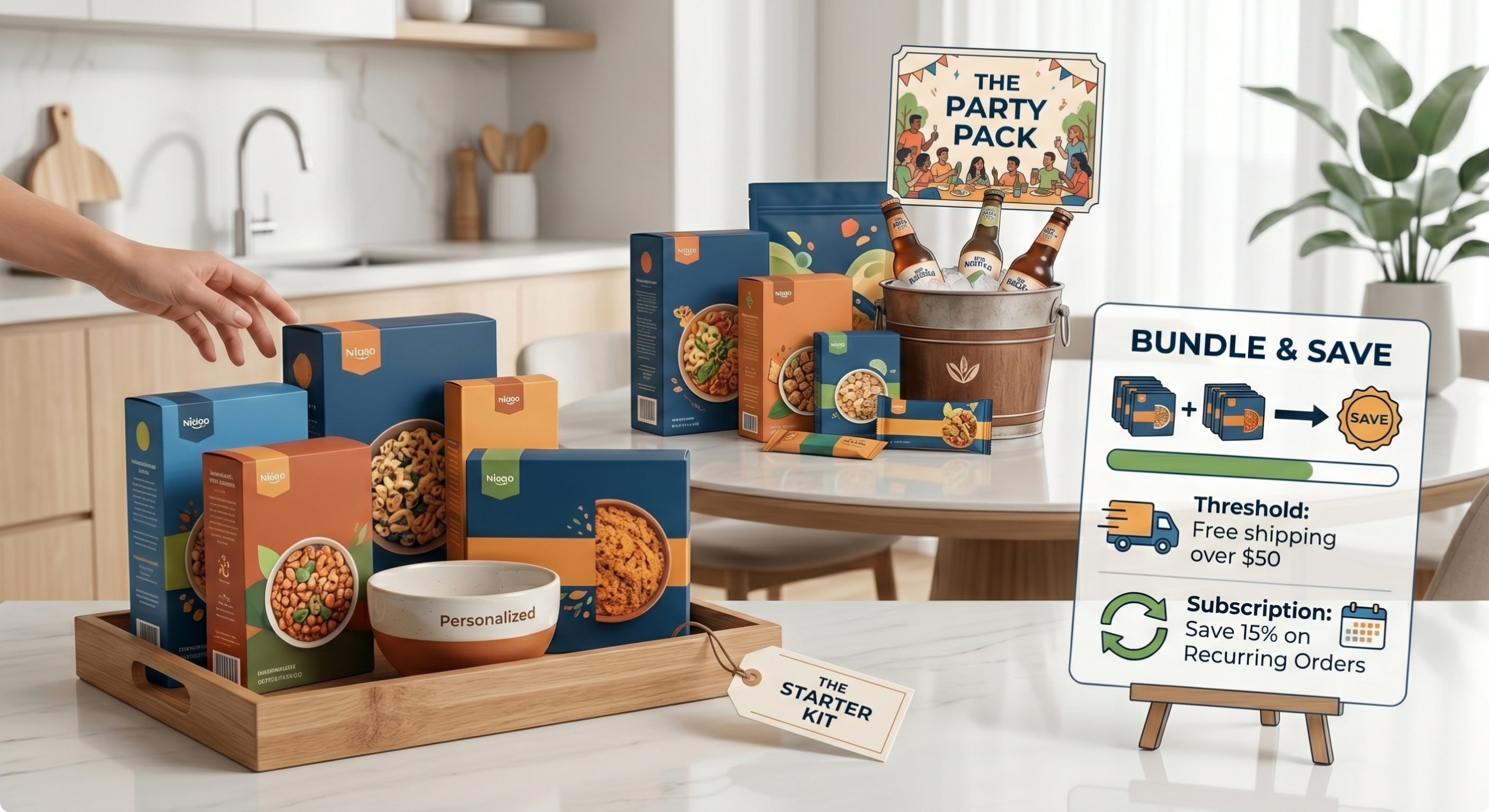
With rising Customer Acquisition Costs (CAC), you cannot afford to sell single units.
-
Bundles: "The Starter Kit" or "The Party Pack."
-
Subscriptions: Save 15% with recurring delivery.
-
Thresholds: "Free shipping on orders over $50." These tactics increase Average Order Value (AOV), allowing you to outbid competitors in the ad auction.
14. Creative Psychology in Food Advertising
The "Neural Resonance" of food is powerful.
-
Macro-shots: Extreme close-ups of texture (crispy, gooey, bubbly).
-
The "Human Element": A hand reaching for a snack or pouring a drink increases relatability.
-
Color Theory: Use reds and yellows to stimulate appetite, or greens and earth tones to signal health and sustainability.
Common Strategic Mistakes in Food & Lifestyle Marketing
Even with a high budget, these four pitfalls can tank your growth.
Over-Reliance on Discounts
If your only lever for growth is "20% off," you are devaluing your brand. Eventually, customers will refuse to buy at full price. Use value-adds (free gifts, exclusive content) instead of constant price slashing.
Under-Investing in Creative Testing
Many brands spend $10,000 on a single high-production commercial that fails. In the modern landscape, it is better to spend $2,000 on production and $8,000 testing 50 different "rough" variations to see what actually converts.
Scaling Paid Media Without Retention Strategy
Getting the first sale is expensive. The profit is in the second, third, and fourth sale. If your email marketing and SMS flows aren't optimized to bring customers back, you are essentially renting your audience from Meta and TikTok.
Ignoring Omnichannel Attribution Complexity
If you only look at "Last-Click" ROAS, you might turn off ads that are actually driving massive retail sales. Use Post-Purchase Surveys (e.g., "Where did you hear about us?") to get a clearer picture of your marketing's true impact.
FAQs
How do I balance Branding and Conversion in Food & Lifestyle Ads?
In this industry, "ugly" doesn't sell, but "too polished" feels like an ad. The current winning formula is "Aesthetic Strategy + Performance Tactics." Use high-quality Key Visuals (KV) for your Top-of-Funnel awareness, but for the Bottom-of-Funnel, utilize authentic-looking UGC. These should be shot realistically—often on a smartphone—but with vibrant colors and fast-paced editing to trigger immediate action.
What are the most important KPIs for Food & Lifestyle marketing?
While ROAS is the standard, two other metrics are crucial for high-level strategy:
-
MER (Marketing Efficiency Ratio): Total revenue (DTC + Retail) divided by total marketing spend. This measures your overall omnichannel effectiveness.
-
Retention Rate / LTV: For food, the first purchase is just the "hook." If customers don't return, your CAC (Customer Acquisition Cost) will eventually outpace your profits.
Should I prioritize short-form video (TikTok/Reels) or static images?
Data shows short-form video dominates attention, especially when using ASMR elements like a can cracking open or a satisfying crunch. However, high-quality static images are highly effective for Retargeting and on platforms like Pinterest or Instagram Shop, where users are actively looking for visual inspiration. A healthy mix is usually 70% video and 30% static.
Why is my CTR high but my conversion rate low?
This often happens when your ad creates an "emotional click" but the Landing Page fails to deliver. Check for:
-
Friction: Is the checkout process too long?
-
Trust Signals: Are there reviews, health certifications, or "as seen in" badges?
-
Offer Clarity: Is the discount or bundle clearly explained?
Should I run ads directly to marketplaces like Amazon or Instacart?
Yes, if your goal is rapid volume. Marketplaces have high trust and built-in logistics, which can boost conversion rates. However, you lose customer data for future remarketing. A balanced strategy often splits the budget: 60% to your own website (to own the data) and 40% to marketplaces (to capture volume and retail momentum).
You may also like: