
In the digital landscape, nonprofits often approach Facebook with a "direct-response" mindset expecting that a well-crafted post or a modest ad spend will immediately trigger a wave of donations. However, the reality of Facebook marketing for nonprofits is far more nuanced. Unlike e-commerce, where a consumer might buy a pair of shoes on impulse, the "product" a nonprofit sells is trust, impact, and a shared vision. These are high-consideration "purchases" that require a sophisticated funnel and a deep understanding of platform mechanics.
This guide moves beyond basic setup instructions. We will explore how to architect a Facebook strategy that respects the long decision-making cycles of donors, leverages the synergy between organic and paid reach, and overcomes the measurement hurdles unique to the social sector.
How Facebook Marketing Actually Works in the Nonprofit Sector
Before clicking "Publish" on a campaign, it is vital to understand the psychological environment of the platform. Facebook is a discovery engine, not a search engine, which fundamentally changes how users interact with nonprofit content.
Facebook Is Not a High-Intent Platform for Donations
When a user is on Google, they might search for "where to donate for climate change," signaling high intent. On Facebook, they are there to connect with friends or consume entertainment. This means most users do not donate on their first exposure to your cause. You are interrupting their leisure time; therefore, your marketing must transition them from "passive scroller" to "invested supporter" through multiple touchpoints.
Difference Between Commercial Intent vs. Mission-Driven Consideration
In commercial marketing, intent is often driven by a physical need or desire. In the nonprofit sector, consideration is mission-driven. A donor isn't looking for a "deal"; they are looking for efficacy and alignment. This requires a longer nurturing process because the user needs to validate that your organization is the best steward of their contribution.
The Nonprofit Decision-Making Cycle on Facebook
Awareness happens early, but conversion happens late. A user may see a video about your impact in January, engage with a few organic posts in February, and only finally click a "Donate" ad in April when a specific matching-gift campaign goes live. Trust accumulation is the primary goal of your Facebook presence, making delayed conversions the standard, not the exception.
The Real Role of Facebook in the Nonprofit Marketing Funnel
To succeed, you must view Facebook as a holistic ecosystem rather than a series of disconnected posts. By categorizing your efforts into a funnel, you ensure that you are meeting potential donors where they are in their journey.
Upper Funnel: Education, Mission Clarity, and Emotional Context
The top of the funnel is where you deliver what Facebook is best at: storytelling. The goal here is not the dollar; it is the engagement signal.
-
Content Types: Educational videos, "day in the life" stories of beneficiaries, and bold statements about the problem your nonprofit solves.
-
Meaningful Signals: Look for long video view times (50%+) and shares, rather than just likes. These signals tell Meta’s algorithm who is actually interested in your mission.
Mid Funnel: Trust, Validation, and Repeated Exposure
This is the most neglected stage in nonprofit marketing. Once someone has engaged with your top-of-funnel content, they need proof.
-
Retargeting Based on Intent: Instead of showing the same "Donate Now" ad, show them a testimonial from a long-term volunteer or an annual impact report summary.
-
Validation: Use this stage to answer the "Why you?" question. Show your transparency, your ratings on charity evaluators, and the specifics of your programs.
Lower Funnel: Donations, Sign-Ups, and Volunteer Actions
Only after the user has been "warmed" do you push for direct conversion.
-
Efficiency: Pushing cold traffic directly to a donation page is often a waste of budget. Cold traffic CPA (Cost Per Acquisition) is significantly higher than retargeting CPA.
-
The Conversion Trigger: Use urgency-based messaging here—matching periods, emergency appeals, or end-of-year tax deadlines.
If you are also managing clients in other sectors, the nurturing process varies significantly. For instance, Facebook marketing tips for real estate agents often focus on lead magnets and property tours, which follow a different trust-building logic.
Organic Facebook Marketing vs. Paid Facebook Ads for Nonprofits
The debate shouldn't be about whether organic or paid is "better." Instead, look at how they function as two parts of a single machine.
Why Organic Content Still Matters for Paid Performance
Organic content acts as the laboratory for your paid ads. It serves three critical functions:
-
Audience Warm-up: It maintains a baseline of presence so that when a paid ad appears, it isn't coming from a "stranger."
-
Retargeting Fuel: You can build custom audiences based on people who have interacted with your organic Page, significantly lowering your ad costs.
-
Lookalike Seed Quality: The better your organic engagement, the higher the quality of the "Seed Audience" you use to create Lookalike Audiences for paid reach.
Paid Ads as a Distribution and Control Layer
While organic is for the "who," paid is for the "how many" and "how often."
-
Frequency Control: Organic reach is at the mercy of the algorithm. Paid ads allow you to ensure your core supporters see your message at a specific frequency (e.g., 3 times a week during a campaign).
-
Creative Testing at Scale: Paid ads allow you to A/B test two different emotional hooks simultaneously to see which one resonates with a broader audience.
-
Accelerating Trust: You can use "Reach" or "Brand Awareness" campaigns to flood a specific geographic area or demographic with your mission, building familiarity faster than organic growth ever could.
Facebook Ads Strategy for Nonprofits (Beyond Basic Campaign Types)
For those who already understand the Meta Ads Manager, the challenge lies in optimizing for low-volume, high-value events.
Campaign Objectives That Actually Make Sense
-
Traffic and Engagement: These are often dismissed as "vanity" objectives, but for nonprofits, they are essential for building the "Engaged" audience bucket for later retargeting.
-
When Conversion Campaigns Fail: If your nonprofit receives fewer than 50 donations a week, the Meta algorithm may struggle to "learn" who your donors are. In these cases, optimizing for a "Landing Page View" or "Add to Cart" (beginning the donation process) can provide the data density the algorithm needs to stabilize.
Structuring Accounts for Low-Frequency Conversion Events
Nonprofits often have small budgets and sparse data. Avoid the "early optimization trap" of narrowing your audience too much.
-
Consolidation: Don't split your budget into ten different ad sets. Consolidate your budget into fewer ad sets to give the algorithm more data per set.
-
Long Decision Cycles: Set your attribution window to 7-day click and 1-day view, but keep in mind that the real impact might take 28+ days to manifest in your CRM.
Retargeting Logic for Nonprofits
Move away from "single-touch" retargeting. Use Time-Based Sequencing:
-
Day 1-7 after visit: Show a high-impact video.
-
Day 8-14 after visit: Show a testimonial or social proof.
-
Day 15-30 after visit: Show the direct donation appeal.
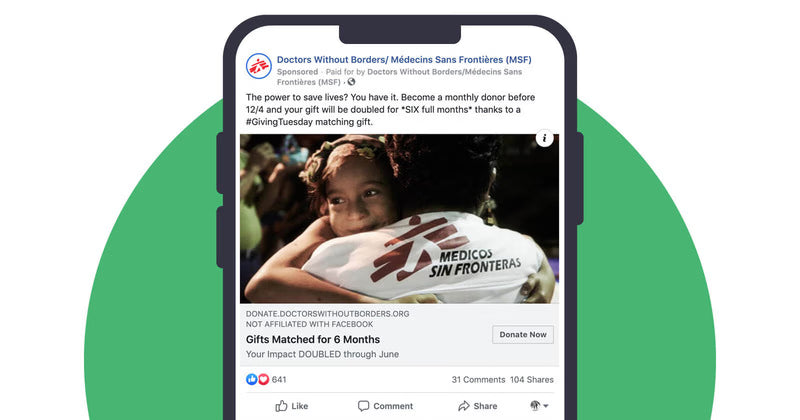
Creative Strategy for Nonprofit Facebook Ads
In a world of "doom-scrolling," your creative must either provide a solution to a problem or a sense of belonging to a movement.
Emotional Storytelling vs. Proof-Based Messaging
-
When Emotion Converts: High-arousal emotions (empathy, urgency, hope) are excellent for top-of-funnel awareness and emergency appeals.
-
When Credibility Matters More: For monthly giving (recurring donations), donors want to see "the math." They want to know exactly how $20/month is spent. Credibility converts the long-term supporter.
Creative Angles That Scale
-
Impact Metrics: "Every $5 provides a meal." This tangible link between money and outcome is the most scalable ad creative for nonprofits.
-
Social Proof and Legitimacy: Featuring "Community Spotlights" or "Donor of the Month" creates a sense of a growing movement.
-
Mission Clarity over Dramatization: Avoid overly "shocking" imagery which can lead to ad fatigue or "empathy burnout." Clarity and hope generally have better long-term retention than guilt.
Managing Creative Fatigue
Nonprofits often "burn" creatives faster than e-commerce brands because the audience pool is usually more specific. To combat this, rotate your creative every 2-4 weeks and vary your formats (e.g., alternating between a static image, a carousel of stories, and a short-form video).
AGROWTH - META AGENCY ACCOUNT
⭐ Managed campaigns with expert guidance
⭐ Flexible invoice-based billings, custom top-ups
⭐ High resistance to suspension via agency tier
⭐ Quick fund transfer to new account if needed
⭐ Priority support via Facebook Partner channel
⭐ Lower fees from 3%
Common Facebook Marketing Mistakes Nonprofits Still Make
Even experienced marketers can fall into these traps when switching to the nonprofit sector.
-
Treating Facebook as a Direct-Response Channel: Expecting a 4x ROAS (Return on Ad Spend) immediately. In nonprofit work, your "return" is the Lifetime Value (LTV) of a donor, which might take 12 months to realize.
-
Overusing Lead Ads Without a Nurturing System: Facebook Lead Ads are great for capturing emails, but if you don't have an automated email sequence ready to welcome those leads, the lead quality will degrade within 48 hours.
-
Scaling Budget Without Scaling Creative: Simply throwing more money at a single ad will lead to high frequency and user annoyance. To scale, you must scale your ideas, not just your dollars.
-
Misreading CPA Signals: A low Cost Per Action is bad if those "actions" are from low-quality leads who never donate. Focus on "Cost per Quality Lead" or "Cost per New Donor."
FAQs
Should we use the "Donate" button on Facebook or link to our website?
While the Facebook "Donate" button has lower friction, sending users to your website allows you to capture their email for your own CRM and retarget them later. For most nonprofits, the website is better for long-term donor retention.
How much should a nonprofit spend on Facebook Ads?
Start with a budget that allows for at least 50 "optimization events" (like clicks or leads) per week. Even $10–$20 a day can provide enough data to begin seeing patterns.
What is a good ROAS for nonprofit ads?
This varies, but many nonprofits aim for a 1:1 or 2:1 ratio on initial acquisition, knowing that the real "profit" comes from the 2nd and 3rd year of a donor's life.
Is it better to use "On-Facebook" donation tools or send traffic to our website?
While the "Donate" button on Facebook offers a seamless, one-click experience (low friction), it often results in "anonymous" donors because you don't always get their full contact data for your CRM. For long-term donor retention, it is usually better to drive traffic to your own website. This allows you to own the data, pixel the users for retargeting, and put them into an automated email nurturing sequence, which is where the real Lifetime Value (LTV) is built.
Further reading