
If you have been running campaigns on TikTok Ads for a while, you already know one major limitation of auction-based buying: unpredictability. Costs fluctuate, delivery can be inconsistent, and scaling becomes harder when performance is volatile. That is where TikTok reach and frequency come in.
This buying model is designed for advertisers who want more control over delivery, impressions, and audience exposure. Instead of competing in real-time auctions, you plan your campaign and let TikTok deliver based on predefined reach and frequency goals.
In this guide, we will break down how TikTok reach and frequency works, when you should use it, how to set it up properly, and what strategies actually make it effective in real campaigns.
What Is TikTok Reach and Frequency?
TikTok Reach and Frequency (R&T) is a reserved buying model that allows advertisers to plan and purchase ad delivery in advance, with predictable reach and controlled exposure frequency.
At its core, this model is built on two fundamental metrics:
-
Reach: The number of unique users who see your ads
-
Frequency: The average number of times each user sees your ads over a defined period
In auction campaigns, these metrics are outcomes. In reach-and-frequency campaigns, they are inputs.
This is a critical distinction. Instead of asking “how many people did I reach?”, you are deciding upfront:
-
How many people do you want to reach
-
How often each person should see your ads
How TikTok Reach and Frequency Buying Works
To use this model effectively, you need to understand how the system actually operates behind the scenes.
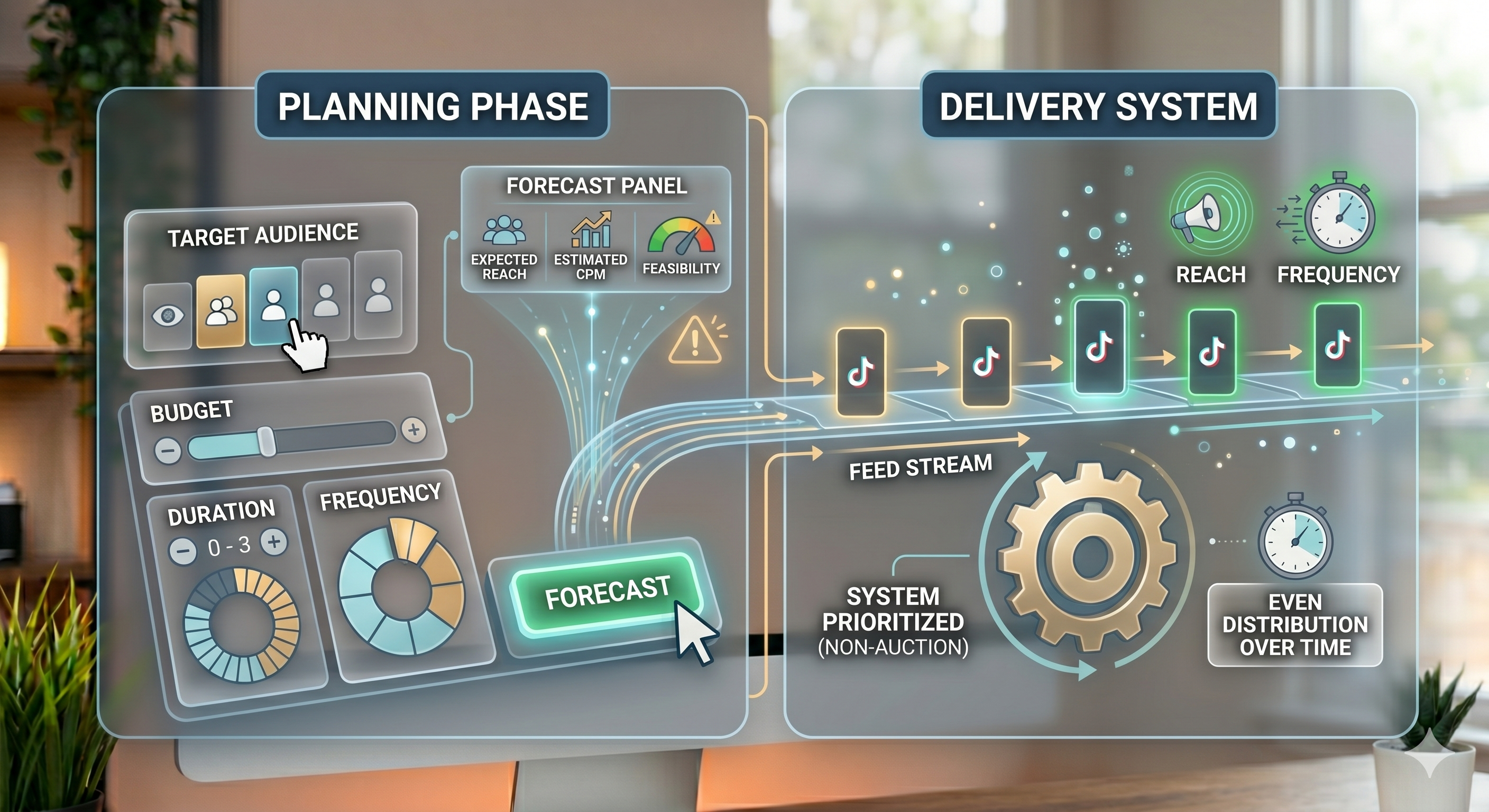
Planning Phase
Everything starts with planning. Before your campaign goes live, you configure:
-
Target audience (size matters significantly)
-
Budget allocation
-
Campaign duration (fixed timeframe)
-
Desired frequency level
Based on these inputs, TikTok generates a forecast, estimating:
-
Expected reach
-
Estimated CPM
-
Delivery feasibility
This forecasting step is not just informational. It determines whether your campaign is viable.
If your audience is too small or your budget too low, the system may not meet your frequency goals.
Delivery System
Once the campaign is approved and launched, TikTok delivers impressions according to the predefined plan.
Key characteristics of delivery:
-
Non-auction priority delivery within constraints
-
Even distribution of impressions across the campaign period
-
Focus on hitting both reach and frequency targets
Unlike auction campaigns, where delivery spikes or drops based on competition, here the system aims for stability and consistency.
Role of Budget and Duration
Budget and duration are not just inputs — they directly shape delivery quality.
-
Budget determines scale
Higher budgets allow broader reach and more stable frequency distribution -
Duration determines pacing
Short campaigns require more aggressive delivery
Longer campaigns allow smoother impression spread
If either is misaligned, performance suffers:
-
Too short → delivery pressure, higher CPM
-
Too long with low budget → weak frequency, low impact
When Should You Use Reach and Frequency Campaigns?
This model is not meant for every objective. It is specifically designed for certain types of campaigns where predictability matters more than optimization flexibility.
Brand Awareness Campaigns
Reach and frequency work best when your goal is to maximize exposure across a large audience.
Typical use cases:
-
Increasing brand recall
-
Driving top-of-funnel visibility
-
Supporting long-term brand positioning
In these scenarios, consistent exposure matters more than immediate conversions.
Product Launches
When launching a new product, timing and message consistency are critical.
Reach and frequency helps ensure:
-
Your target audience sees the message multiple times
-
Delivery is concentrated within a defined launch window
This is especially useful for:
-
New product rollouts
-
Seasonal campaigns
-
Limited-time offers
Market Expansion
If you are entering a new market or scaling into a broader audience segment, you need controlled exposure.
Reach and frequency allow you to:
-
Systematically introduce your brand
-
Avoid under-delivery or over-exposure
-
Maintain consistent messaging across regions
Key Benefits of TikTok Reach and Frequency
Moving away from the auction isn't just about control; it’s about the strategic advantages that come with a reserved model.
Predictability and Price Locking
The biggest draw is the fixed CPM. Once you book your campaign, the price is locked. Even if TikTok traffic suddenly becomes more expensive due to a major event (like Black Friday or the Super Bowl), your costs remain the same.
Controlled Exposure (Frequency Capping)
One of the biggest killers of ad performance is "ad fatigue." In the auction, a small, high-value audience might see your ad 15 times in three days, leading to annoyance. Reach and Frequency allows you to set a strict frequency cap (e.g., no more than 2 exposures per week), preserving your brand sentiment and your budget.
Better Multi-Channel Planning
Because you know exactly when your ads will deliver and to whom, you can coordinate your TikTok spend with YouTube, Meta, or even OOH (Out-of-Home) advertising. This creates a synchronized "surround sound" effect for your marketing message.
How to Set Up TikTok Reach and Frequency Campaigns
Setting up an R&F campaign requires a more methodical approach than an auction campaign. You are effectively signing a digital contract for inventory, so the details must be precise.
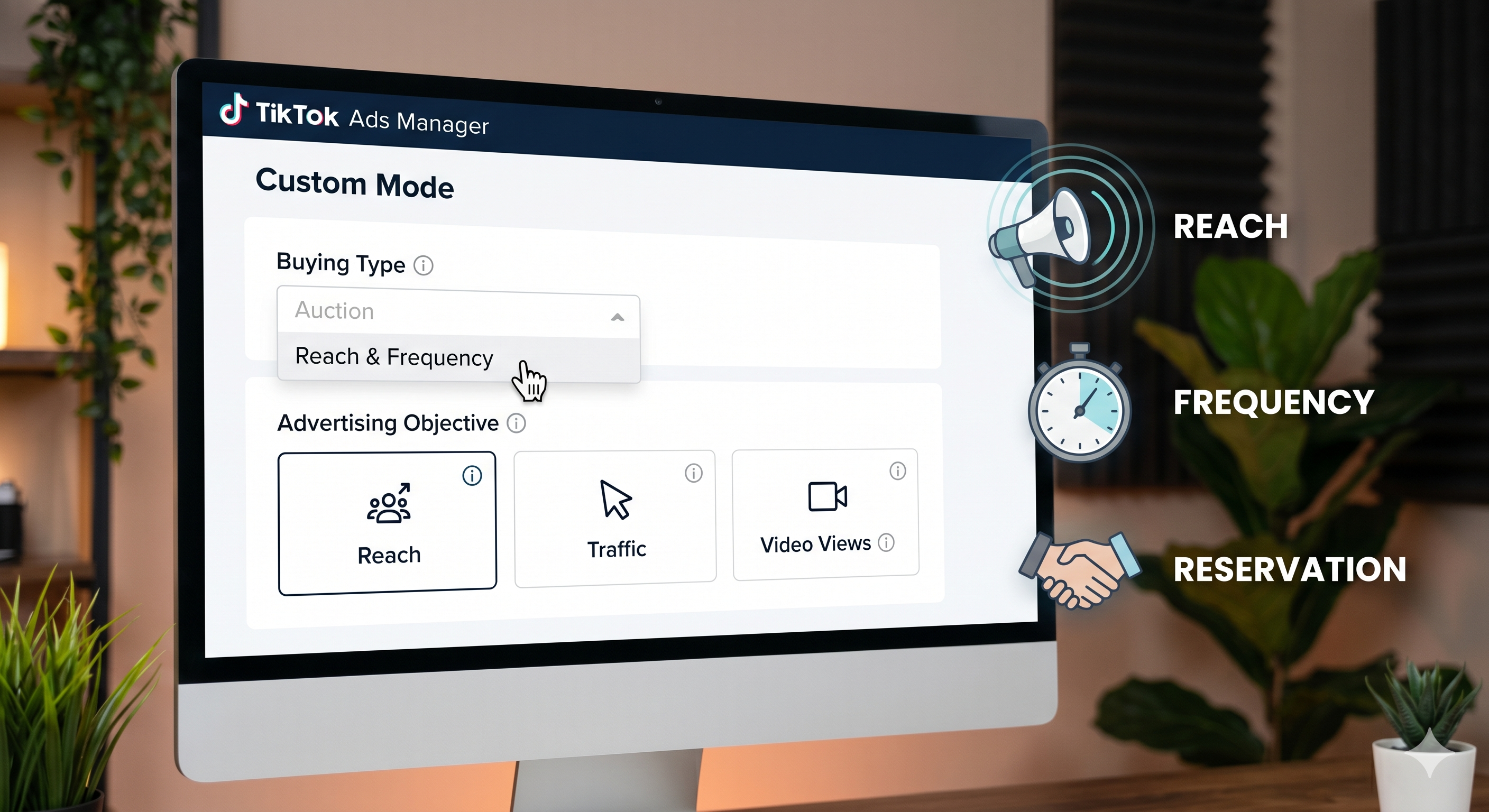
Step 1: Campaign Level Initiation
In your TikTok Ads Manager, click Create and select Custom Mode.
-
Buying Type: You must toggle this from "Auction" to Reach & Frequency.
-
Advertising Objective: Choose from Reach, Traffic, or Video Views. Note that "App Install" and "Conversion" are typically reserved for the auction model, as R&F focuses on the top-of-funnel impact.
You can also read all about TikTok ads objective and how to choose suitably for your campaign right here!
-
Campaign Name & Settings: Give your campaign a clear identifier. You can also enable Campaign Budget Optimization (CBO) if you plan to run multiple ad sets and want TikTok to distribute the reserved volume across them.
Step 2: Ad Set Configuration & Targeting
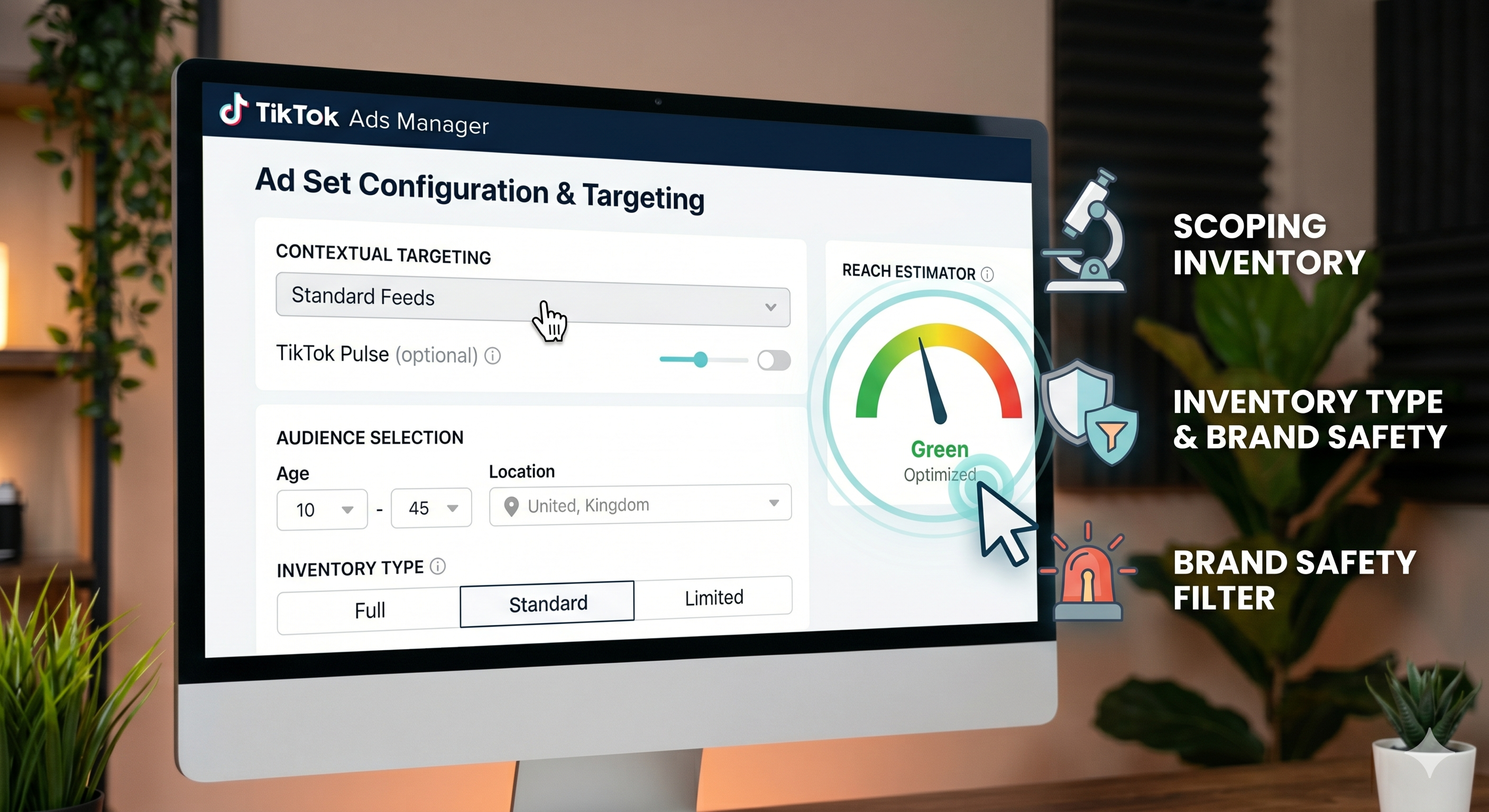
This is where the R&F model differs most from the auction. You aren't just targeting; you are "scoping" the available inventory.
-
Contextual Targeting: You can select specific "Standard Feeds" or use TikTok Pulse (if available) to place your ads next to the top 4% of trending content.
-
Audience Selection: Define your demographics, interests, and devices.
Pro Tip: Keep an eye on the Reach Estimator on the right side of the screen. If your audience is too narrow, you won't be able to book the campaign because the system cannot guarantee the volume.
-
Inventory Type: Choose between Full, Standard, or Limited Inventory based on your brand safety requirements.
Step 3: Schedule and Reservation Strategy
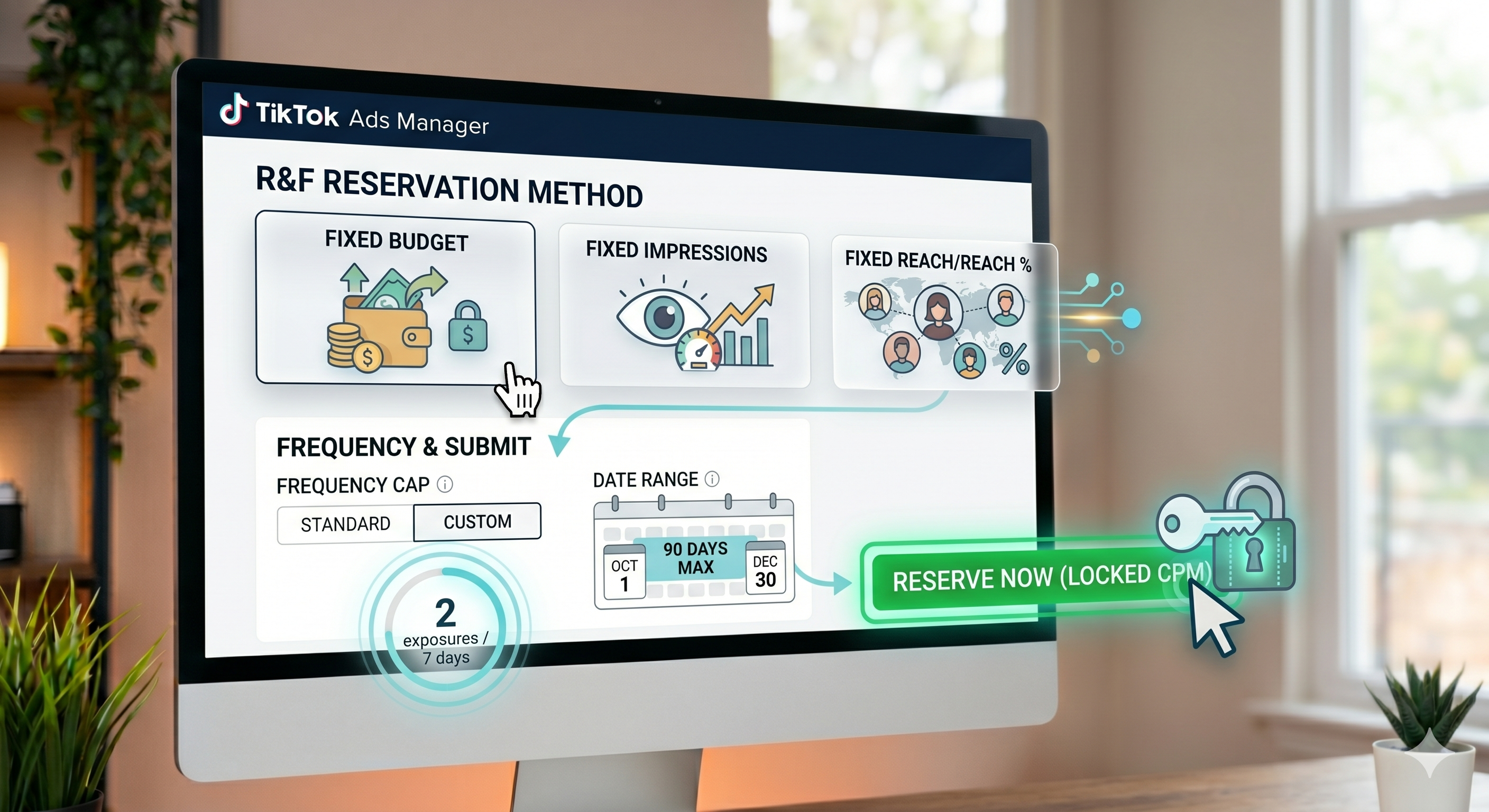
Unlike auction ads that run indefinitely, R&F campaigns require a fixed start and end date (up to 90 days in advance).
-
Reservation Method: You can choose:
-
Reserve Using Fixed Budget: You have a specific budget and want to spend it all on this campaign.
-
Reserve Using Fixed Impressions: You have a specific impression goal.
-
Reserve Using Fixed Reach or Fixed Reach Percentage: You have a specific reach or reach percentage as your campaign KPI.
-
Frequency Cap: Select how often you want your audience to see your ads. You can choose a "Standard" frequency or "Custom" to set specific limits (e.g., 2 exposures every 7 days).
-
The "Submit" Moment: Once you have configured these settings, you must click Reserve. This locks in the CPM (Cost Per Mille) and ensures that other advertisers cannot bid away your inventory.
Step 4: Multi-Creative and Ad-Level Setup
After reserving your "spot" in the TikTok feed, you move to the creative level.
-
Ad Formats: R&F supports standard In-Feed Ads, TopView (in some regions), and Spark Ads.
-
Creative Sequencing: If you want to use advanced storytelling, this is where you upload multiple videos. You can set the system to deliver them in a specific order or rotate them randomly to minimize ad fatigue.
-
Call to Action (CTA): Even though this is a reach-focused campaign, you can still use Dynamic CTAs or standard buttons to drive traffic to your landing page or TikTok Instant Page.
Step 5: Review and "Buy"
Before the campaign goes live, you must do a final review of the Purchase Order. This summary will show you:
-
Total Reach: The estimated number of unique users.
-
Frequency: The average exposure per user.
-
CPM: Your fixed price.
-
Spend: The total budget you are committing to.
Once you click Submit, the campaign moves into the "Pending" state until your start date arrives. Ensure your creative assets are uploaded and approved at least 24–48 hours before the start time to avoid delivery delays.
How to Choose the Right Frequency
For professional media buyers, frequency is the lever that determines the success of a campaign. Setting it too low results in zero recall; setting it too high wastes money.
Frequency According to the Funnel
The "one-size-fits-all" approach to frequency is a myth. You must align your frequency with your specific objective:
-
Awareness (The Whisper): A frequency of 1–2 per week. This is enough to keep your brand top-of-mind without being intrusive.
-
Consideration (The Conversation): A frequency of 3–5 per campaign period. This allows you to show different angles of your product, helping the user move from "What is this?" to "I might need this."
-
Conversion/Action (The Shout): A frequency of 6-10+. For high-stakes launches or limited-time offers, you need a higher frequency to cut through the noise and drive an immediate click.
The Trade-off: Recall vs. Fatigue
You must monitor the "Effective Frequency" line.
-
The Threshold of Recall: Research suggests users need to see an ad at least 3 times on TikTok to remember the brand.
-
The Fatigue Point: After 10+ exposures of the same creative, CTR usually plummets and CPA rises.
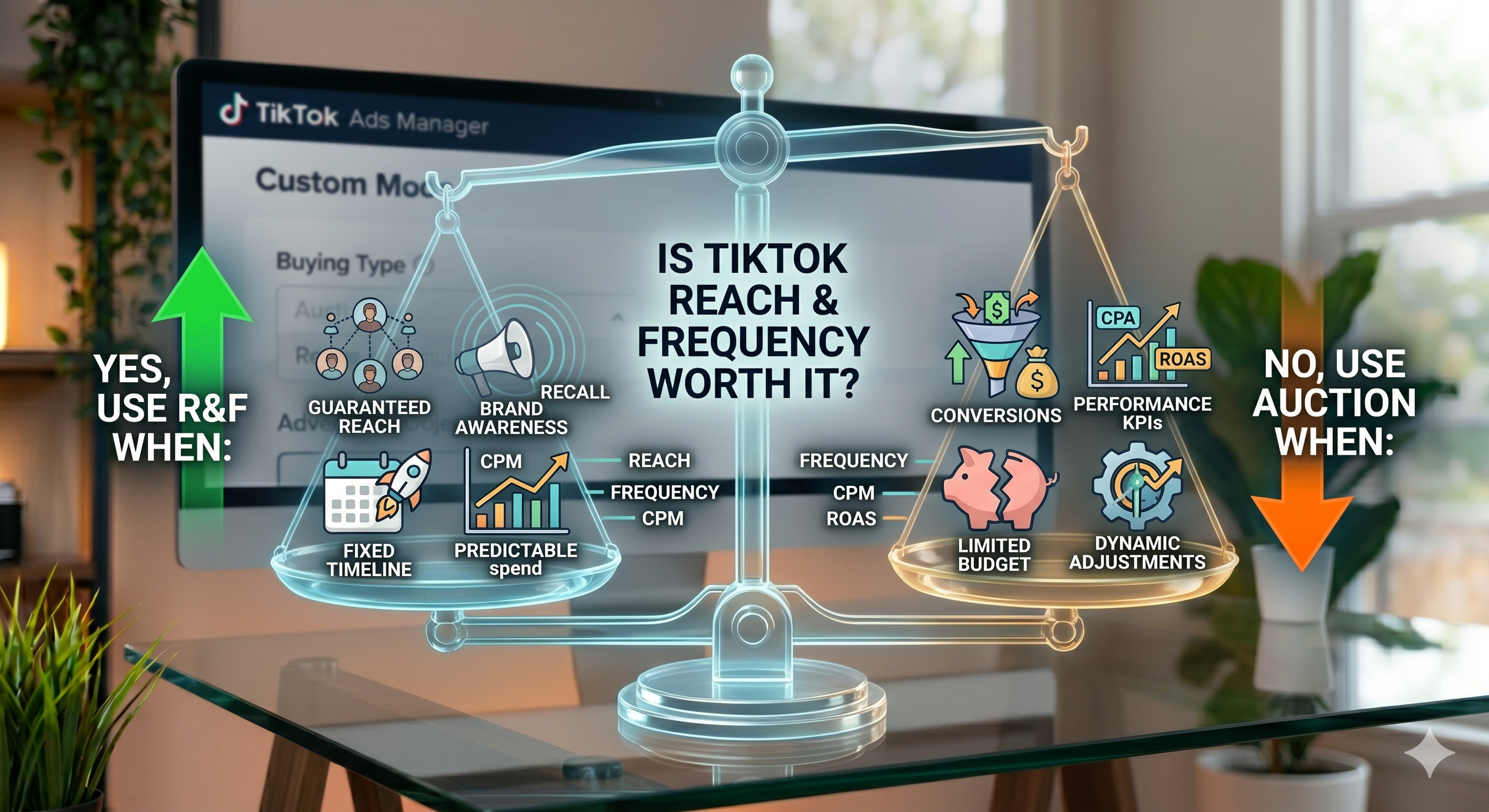
Is TikTok Reach and Frequency Worth It?
It depends on your objective, budget structure, and tolerance for delivery volatility.
To evaluate it properly, you need to look at it through a decision framework rather than a binary yes-or-no lens.
When TikTok Reach and Frequency Are Worth It
Reach and frequency become a strong lever when control and predictability matter more than algorithmic optimization.
It is particularly effective in the following scenarios:
1. You need guaranteed reach at scale
If your campaign requires reaching a large portion of a defined audience within a fixed timeframe, this model provides that assurance. Auction campaigns cannot guarantee delivery due to competition and fluctuating CPM.
2. You are running brand awareness or upper-funnel campaigns
When success is measured by:
-
Reach
-
Frequency
-
Ad recall
Then controlled exposure is more valuable than conversion optimization. This is where reach and frequency outperform auction buying.
3. You are launching a product or campaign with a fixed timeline
For launches, timing is critical. You need:
-
Consistent exposure
-
Even distribution of impressions
-
Message repetition within a short window
Reach and frequency ensure your audience sees the message enough times before the campaign ends.
4. You want stable CPM and predictable spend allocation
With forecasting in place, you can estimate:
-
Cost per thousand impressions
-
Total reach potential
This makes it easier to align media spend with business planning, especially in multi-channel campaigns.
When It Is NOT Worth It
Despite its advantages, reach and frequency is not universally effective. In some cases, it can actually limit performance.
1. You are optimizing for conversions or performance KPIs
If your primary goal is:
-
CPA
-
ROAS
-
Conversions
Then, auction campaigns are more suitable because they allow:
-
Real-time optimization
-
Algorithmic learning
-
Dynamic bidding adjustments
Reach and frequency lack this flexibility.
2. Your budget is limited or fragmented
This model requires a minimum viable budget to work effectively. If your budget is too small:
-
Reach becomes restricted
-
Frequency becomes inefficient
-
Delivery may not meet targets
3. You rely on continuous optimization and testing
In auction campaigns, you can:
-
Adjust bids
-
Swap creatives
-
Optimize targeting dynamically
Reach and frequency campaigns are more rigid once launched, making them less suitable for iterative testing.
4. Your creatives are not strong enough to sustain repeated exposure
High frequency amplifies both strengths and weaknesses. If your creatives are not engaging:
-
Performance will decline quickly
-
Ad fatigue will occur faster
FAQs
Who is the Reach and Frequency Campaign For?
It is designed for mid-to-large-scale advertisers, brand managers, and performance agencies who need to guarantee delivery for specific marketing milestones. It is particularly effective for those who have moved past the "testing" phase and are looking to dominate a market segment.
Can I change my targeting after booking?
No. Once a Reach and Frequency campaign is reserved and the price is locked, your targeting options are generally fixed. This is why the planning phase in the Campaign Planner is so critical.
What happens if my creative is rejected?
If your creative is rejected and you cannot replace it in time, you risk losing your reserved inventory. Always have "backup" creatives that have already passed the TikTok ad review process to ensure zero downtime